



AI Summary
This article explains how to work with a psyllium powder manufacturer for private label needs through a clear step-by-step process. It covers defining product requirements, shortlisting experienced manufacturers, reviewing capabilities, testing samples, finalizing packaging, checking documentation, clarifying commercial terms, starting with a pilot order, setting communication systems, and building a long-term supply relationship. The main idea is that private label success depends on choosing a reliable manufacturing partner and managing the process with clarity and discipline.
Introduction
Working with a psyllium powder manufacturer for private label needs is not just a sourcing decision. It is a business partnership that directly affects product quality, brand reputation, customer trust, and long-term market growth. Private label buyers often focus first on price or packaging design, but successful private label development begins much earlier, with the right manufacturer selection, technical alignment, documentation review, and production planning.
Psyllium powder is widely used in digestive wellness products, fiber supplements, functional food applications, nutraceutical products, and health-oriented formulations. Because of this wide usage, brands entering the market need more than just bulk supply. They need a manufacturer that understands consistency, hygiene, quality testing, scalable production, and the demands of private label execution. A poor manufacturing partner can create issues such as inconsistent powder quality, packaging errors, delayed shipments, unclear compliance records, or lack of customization support.
Private label business also requires strong coordination between both sides. The buyer must communicate clearly about the target market, product format, packaging size, label expectations, and commercial goals. The manufacturer must be capable of turning those requirements into a stable, compliant, and market-ready product. When both sides are aligned, private labeling becomes smoother, faster, and more commercially successful.
Step 1: Define Your Private Label Psyllium Powder Requirements Clearly
The first step in working with a psyllium powder manufacturer is to define exactly what you want to launch under your own brand. Many private label projects become delayed because the buyer begins discussions without a clear product brief. Before contacting manufacturers, you should know the intended product type, target audience, market positioning, packaging format, and expected order volume.
You should also define whether you need plain psyllium powder, a specific mesh size, a food-use product, a nutraceutical-grade offering, or a powder intended for a particular application. Your private label brief should include expected pack sizes, label language, quantity goals, and preferred supply model. If these details are not clear at the beginning, it becomes difficult to compare manufacturers properly.
A well-defined requirement helps the manufacturer understand your expectations and helps you receive more relevant quotations, samples, and production guidance.
Export Ready Psyllium, Spices & Grains Await! CALL US



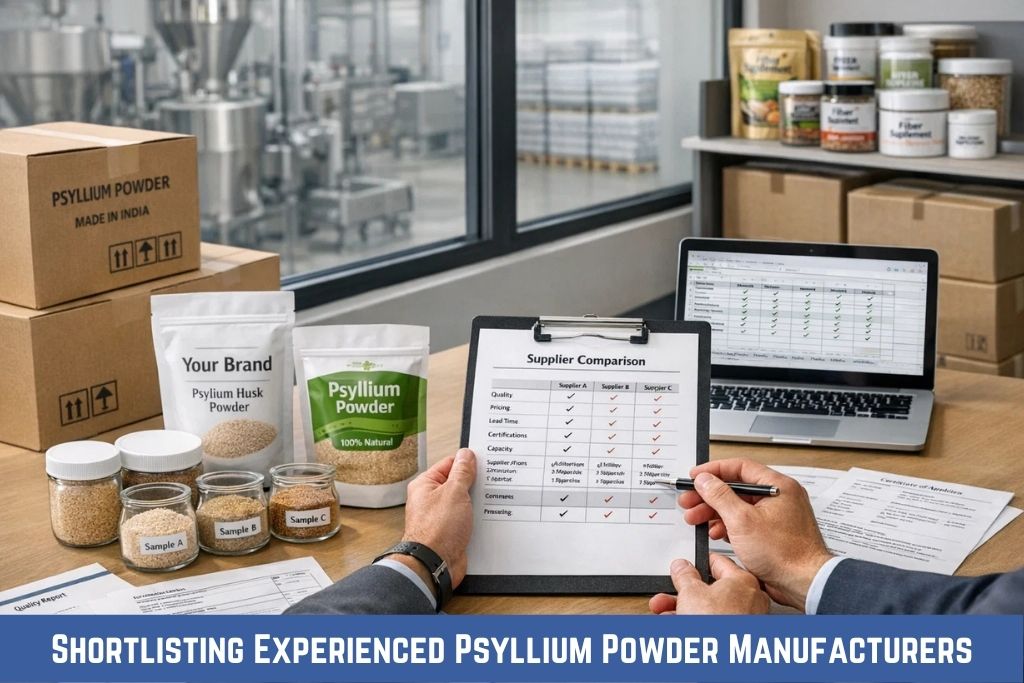
Step 2: Shortlist Psyllium Powder Manufacturers with Relevant Experience
Not every supplier is the right fit for private label work. Some companies may be strong in bulk commodity trade but weak in branding support, retail packaging, or documentation discipline. That is why the second step is to shortlist manufacturers that have relevant experience in psyllium powder processing and private label supply.
A suitable manufacturer should understand batch consistency, export or wholesale handling, packaging coordination, and buyer-specific requirements. Experience matters because private label work demands more than product availability. It involves technical precision, organized communication, and the ability to manage customized output without compromising quality.
When evaluating manufacturers, look for signs of structured operations, familiarity with private labeling, and the ability to support long-term business growth rather than just one-time orders.
Step 3: Review Psyllium Powder Specifications and Manufacturing Capabilities
Once you identify a few suitable manufacturers, the next step is to review their product specifications and manufacturing strength. The manufacturer should be able to explain the grade of psyllium powder they offer, how the product is processed, and how they maintain batch quality.
For private label needs, this discussion should go beyond basic sales language. You should check whether the manufacturer can meet your desired texture, consistency, packaging size, and volume requirements. It is also useful to understand whether the company has proper cleaning, grinding, blending, filling, and packing capabilities if your project requires finished private label supply rather than loose bulk powder.
A manufacturer with strong capability will usually provide technical clarity, specification sheets, testing support, and a realistic production plan. This is important because private label buyers need dependable execution, not vague assurances.
Step 4: Request Psyllium Powder Samples and Evaluate Product Performance
A sample review is one of the most important steps in the entire private label process. Before approving any manufacturer, you should request samples and assess whether the psyllium powder matches your product expectations. The sample should be reviewed for appearance, texture, consistency, handling, and suitability for the intended market.
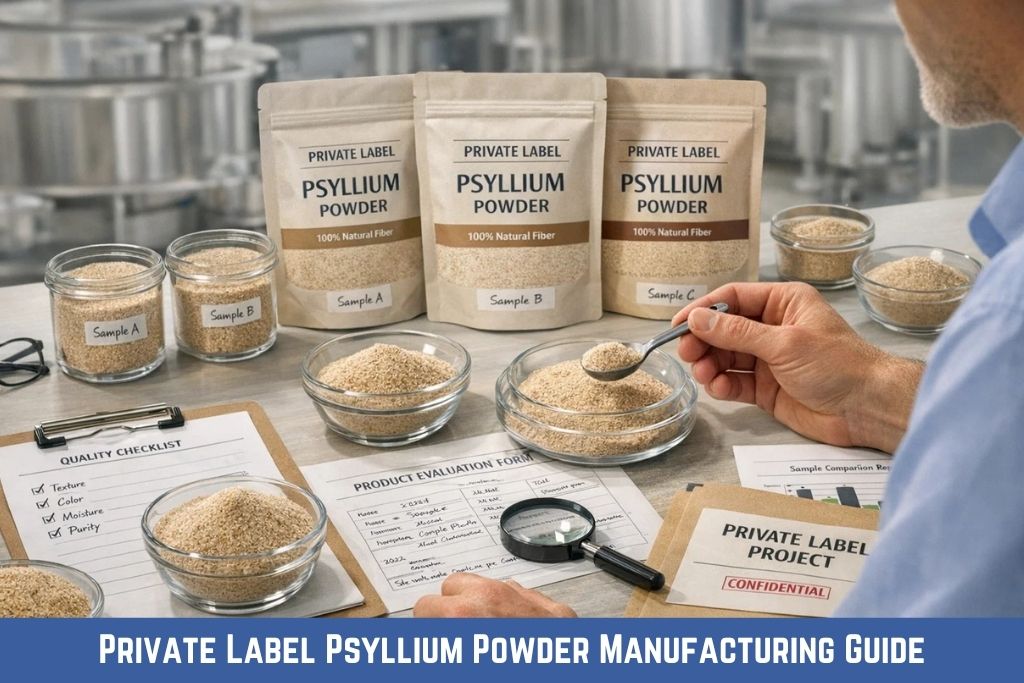
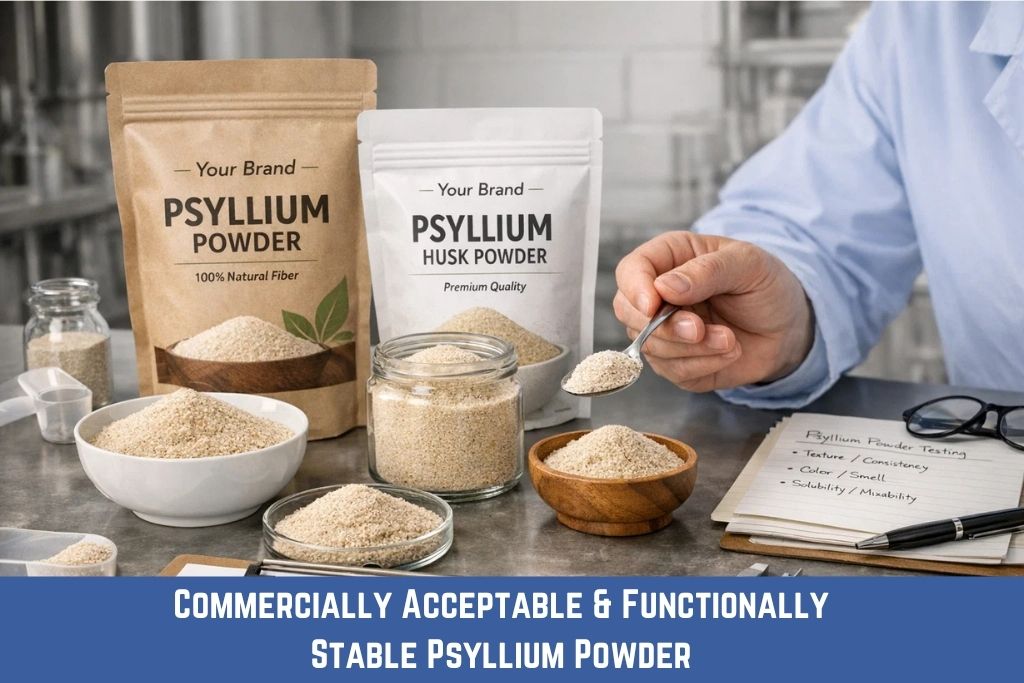
If the product is being positioned in retail, wellness, food, or supplement channels, then the powder should feel commercially acceptable and functionally stable. A high-quality sample gives you a better idea of what the manufacturer can deliver on a larger scale. It also helps identify whether the product is aligned with your brand promise.
Sample testing should not be rushed. It is better to spend time evaluating the product early than to discover quality gaps after packaging design, production planning, or launch investment has already started.
Step 5: Discuss Private Label Packaging and Psyllium Powder Branding Requirements
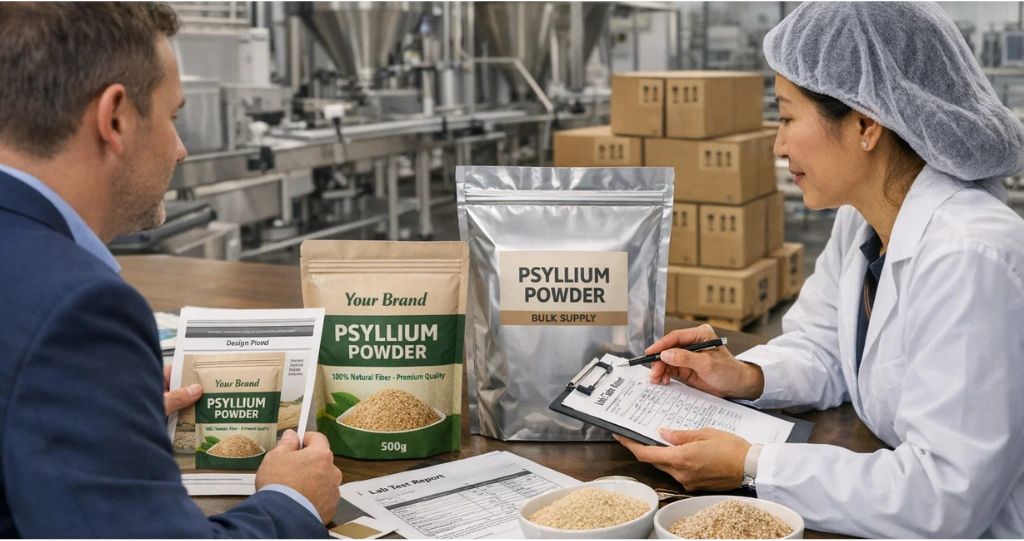
Private label success depends heavily on packaging coordination. Once the product sample is acceptable, you should begin a detailed discussion on how the product will be packed and presented under your brand. This includes pack size, pouch or container style, labeling format, design placement, coding details, and any buyer-specific packaging instructions.
The manufacturer should clearly explain what packaging options they support and whether they can handle branded packing directly or whether packaging materials need to be supplied by the buyer. You should also confirm artwork approval processes, print accuracy expectations, and the final format in which the goods will be packed.
A reliable manufacturer will not treat packaging as a last-minute activity. In private label projects, packaging is part of the product itself. Clear communication at this stage helps avoid costly rework, print mistakes, and dispatch delays.
Step 6: Verify Psyllium Powder Documentation, Testing, and Compliance Readiness
Private label buyers should always verify whether the manufacturer can support the documentation required for the target market. This includes product specifications, quality test records, batch documentation, and any compliance-related paperwork that supports smooth trade and commercial confidence.
The exact documentation needed may vary depending on the product category and destination market, but buyers usually expect a manufacturer to be organized, transparent, and technically prepared. If a manufacturer struggles to provide basic product details or test documentation, it may indicate poor internal systems.
Documentation readiness is especially important for importers, wholesalers, and growing brands that need a dependable partner. Strong paperwork discipline often reflects strong manufacturing discipline.
Step 7: Clarify Psyllium Powder MOQ, Lead Time, and Commercial Terms
Private label development should move forward only after the commercial structure is clearly discussed. This includes minimum order quantity, lead time, packing charges, payment terms, dispatch planning, and repeat order expectations. Many misunderstandings in private label trade happen because operational terms are left unclear until production begins.
You should know the smallest private label quantity the manufacturer accepts, how long sampling-to-production takes, and whether there are separate timelines for packaging procurement, production, and shipment dispatch. Commercial clarity helps you plan your launch better and align your inventory expectations with real production capability.
A professional manufacturer will usually explain these details transparently and help you understand what is possible at your current order scale.
Step 8: Confirm Pilot Order Before Full-Scale Psyllium Powder Rollout
Before moving into large-scale production, it is wise to begin with a pilot order or controlled initial batch. This step gives both the buyer and the manufacturer an opportunity to verify real production performance under commercial conditions. It helps confirm product consistency, packaging accuracy, coding, sealing, dispatch readiness, and overall coordination.
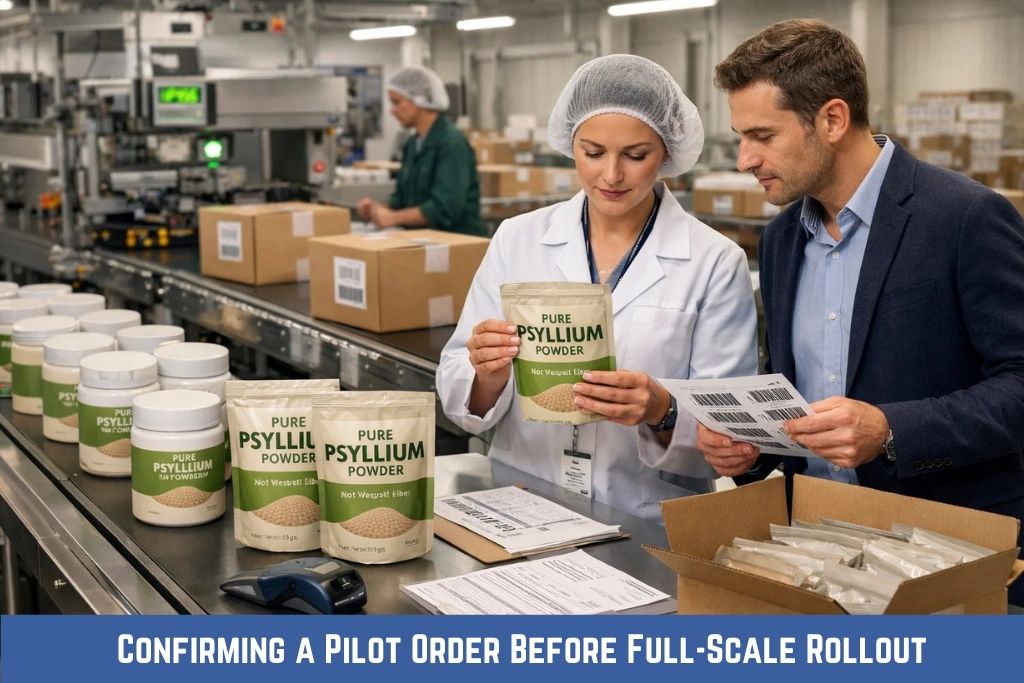
A pilot order is especially useful for new brands, new markets, and first-time manufacturing relationships. It reduces the risk of large-volume errors and gives you practical confidence in the manufacturer’s ability to execute your private label requirements properly.
Rather than seeing the pilot run as a small transaction, treat it as a live performance test for the long-term partnership.
Step 9: Establish Communication and Psyllium Powder Quality Control Protocols
Private label manufacturing works best when communication is structured. After the pilot stage, both sides should define how future orders will be managed, how approvals will be shared, and how any quality concerns will be handled. This includes artwork approvals, batch confirmations, dispatch updates, packaging verification, and lot traceability.
A strong manufacturer relationship depends on consistency and responsiveness. You should know who will handle technical queries, who confirms production schedules, and how quality feedback will be communicated. If communication is disorganized, even a good product can become difficult to manage over time.
Well-defined coordination procedures support smoother production cycles and fewer avoidable errors.
Get Bulk Psyllium, Spices & Grains QUOTES TODAY!

Step 10: Build a Long-Term Psyllium Powder Supply Relationship, Not Just a One-Time Purchase
The final step is to approach the manufacturer relationship as a long-term supply partnership rather than a one-time purchase. Private label growth depends on repeatability, trust, and the ability to scale without compromising quality. Once a manufacturer has proven capable, it is wise to build a structured working relationship that supports future expansion.
This includes discussing forecast planning, repeat packaging runs, stable product specifications, and expected growth volumes. Manufacturers are often better able to support serious buyers when they understand future demand and brand direction. In return, buyers benefit from stronger continuity, smoother production planning, and better operational reliability.
Private label success becomes much more sustainable when the relationship is built on planning, discipline, and mutual clarity.
Conclusion
Working with a psyllium powder manufacturer for private label needs requires much more than choosing a supplier from a quotation list. It involves defining product requirements, evaluating manufacturer capability, testing samples, finalizing packaging, verifying documentation, clarifying commercial terms, and building a dependable long-term working model. Each step plays a role in protecting your brand quality and supporting a smoother market launch.
For private label Psyllium powder buyers, the right manufacturer is not only a production source but also a key business partner. A capable manufacturer helps ensure product consistency, cleaner execution, stronger packaging outcomes, and fewer operational surprises. By following a structured selection and coordination process, brands can improve their chances of launching a successful private label psyllium powder product with greater confidence.
FAQs
What is the first step in working with a psyllium powder manufacturer for private label?
The first step is to define your product requirements clearly. You should know your target market, packaging format, product type, and expected quantity before approaching manufacturers.
Why is manufacturer experience important for private label psyllium powder?
Experience matters because private label work requires more than bulk supply. A capable manufacturer should understand packaging, quality consistency, documentation, and customized execution.
Should buyers always request a sample before placing an order?
Yes, requesting a sample is essential. It helps evaluate the powder’s quality, texture, consistency, and suitability before moving into commercial production.
What should be discussed about private label packaging?
Buyers should discuss pack size, packaging material, label format, printing, coding, sealing, and artwork approval. These details help avoid packaging errors later.
Why are documents important in private label manufacturing?
Documents show whether the manufacturer is organized and quality-focused. Proper specifications, test records, and batch support build trust and reduce trade risk.
What does MOQ mean in private label supply?
MOQ means minimum order quantity. It is the smallest quantity a manufacturer is willing to produce for a private label order.
Why is a pilot order useful before a full launch?
A pilot order helps test real production conditions. It allows the buyer to check product consistency, packaging accuracy, and manufacturer coordination before scaling up.
How does communication affect private label success?
Clear communication reduces mistakes and keeps production organized. Good coordination helps with approvals, dispatch planning, quality handling, and repeat order management.
Can a private label manufacturer support long-term brand growth?
Yes, the right manufacturer can support growth by maintaining consistent quality, scalable production, and reliable supply over repeated orders.
Section Title

Mihir Shah is the CEO of Giriraj Enterprise, a trusted manufacturer, supplier, and exporter of Psyllium products, whole spices, ground spices, herbal products, guar gum and other agro products including Psyllium Husk, Psyllium Seeds, Psyllium Husk Powder and Kha Kha Powder. Founded in 1973 and based in Unjha, Gujarat, Giriraj Enterprise has grown significantly under Mihir’s leadership, establishing itself as a trusted name in the global market. With a focus on high-quality standards and adherence to international food norms, the company serves a wide customer base across the globe.
A strategic thinker with a passion for sustainable growth, Mihir has played a pivotal role in expanding the company’s production capacity, which now stands at 3,000 quintals per month, and in ensuring that Giriraj Enterprise remains at the forefront of innovation in the industry. His commitment to quality is reflected in the company’s stringent in-house quality testing and third-party verification, ensuring that all products meet the highest standards of excellence. He is dedicated to driving customer satisfaction by offering fast, reliable services both domestically and internationally.
Through his writing, Mihir shares valuable insights and knowledge about Psyllium, spices, herbal and other agro products, educating readers on their benefits and the role they play in promoting health and well-being. His goal is to provide factual, transparent information to help consumers and businesses make informed decisions.