

AI Summary

Quinoa seed export from India demands strict compliance with international certification frameworks – including ISO 22000:2018, FSSAI organic standards and guidelines. This article outlines what documentation, labelling and regulatory requirements exporters must meet to access the USA, EU and Middle East markets – along with what international buyers should verify before sourcing from Indian quinoa seed suppliers and manufacturers.

ISO 22000:2018 Certification: What Exporters and Buyers Must Know

ISO 22000:2018 is the international benchmark for food safety management systems and it is non-negotiable for any serious quinoa seed supplier targeting regulated global markets. This standard integrates HACCP principles with broader supply chain risk management – covering everything from raw material sourcing to final despatch.

For exporters, maintaining ISO 22000:2018 means conducting regular internal audits, documenting corrective action procedures and ensuring traceability across each production batch. Giriraj Enterprise, a certified quinoa seed manufacturer in India, operates under ISO 22000:2018 and GMP frameworks, providing buyers with documented food safety assurance from farm to final packaging. For importers in regulated jurisdictions, ISO certification reduces customs-level scrutiny and serves as a pre-qualification standard for retailer onboarding.

Get Bulk Psyllium, Spices & Grains QUOTES TODAY!

WhatsApp

FSSAI Licensing: The Regulatory Foundation for Indian Exporters

The Food Safety and Standards Authority of India (FSSAI) is the primary domestic food regulatory body whose licensing is mandatory for all food businesses involved in manufacturing, processing or export. For quinoa seed exporters, a valid FSSAI licence is the baseline document required in every export transaction.

Beyond licensing, FSSAI also issues export certificates upon request, which are recognised by several importing countries as proof of product compliance with Indian food safety law. FSSAI’s standards for quinoa align broadly with guidelines, making the certification relevant not just domestically but as a supporting document in international trade documentation packages.

Organic Certification: NPOP, NOP and EU Organic Standards

Certified organic quinoa commands significantly higher price premiums across all major markets. In India organic certification for export is governed by the National Programme for Organic Production (NPOP), which is recognised as equivalent to EU Organic Regulation (EC) No. 834/2007 – meaning NPOP-certified products can enter the EU without requiring additional organic conversion certification.

For the US market, exporters must additionally hold NOP (National Organic Program) certification under USDA oversight, as NPOP and NOP are not mutually equivalent. Middle Eastern buyers increasingly request third-party organic verification aligned with IFOAM (International Federation of Organic Agriculture Movements) standards, particularly for premium retail channels.

Many suppliers offering private label quinoa seeds services must clearly communicate which organic standards their facility is certified against, since mislabelling organic status carries severe legal consequences in both the EU and the USA.

HALAL, KOSHER and HACCP: Market-Specific Certifications That Drive Buyer Confidence

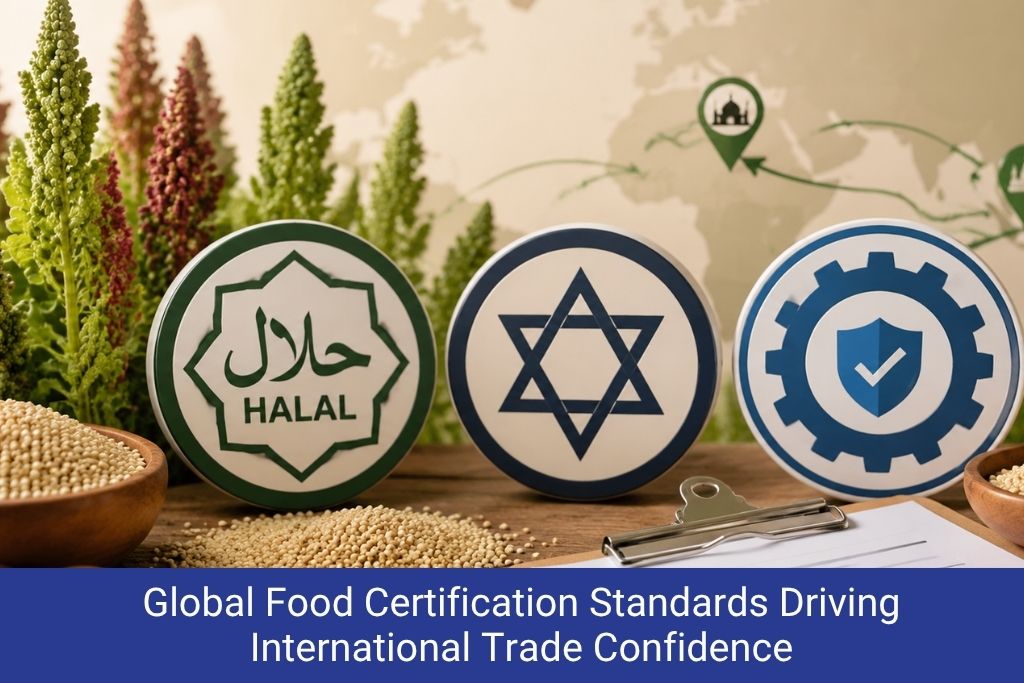
For Middle Eastern and Southeast Asian markets, HALAL certification is a commercial necessity rather than an optional value-add. HALAL-certified quinoa seed suppliers are preferred by importers in the UAE, Saudi Arabia and Malaysia. Certification from a globally recognised HALAL body – such as JAKIM-approved certifiers or IFANCA – is typically required for retail distribution.

KOSHER certification opens access to Jewish market segments in the USA, Canada, Israel and Europe. It also serves as an indirect quality signal in mainstream retail. HACCP documentation, while embedded within ISO 22000, is often requested separately as a standalone document by food safety auditors at destination ports.

Giriraj Enterprise holds HALAL, KOSHER and HACCP certifications, which are directly relevant for buyers navigating multi-market distribution strategies.

Packaging Requirements for USA, EU and Middle East Markets

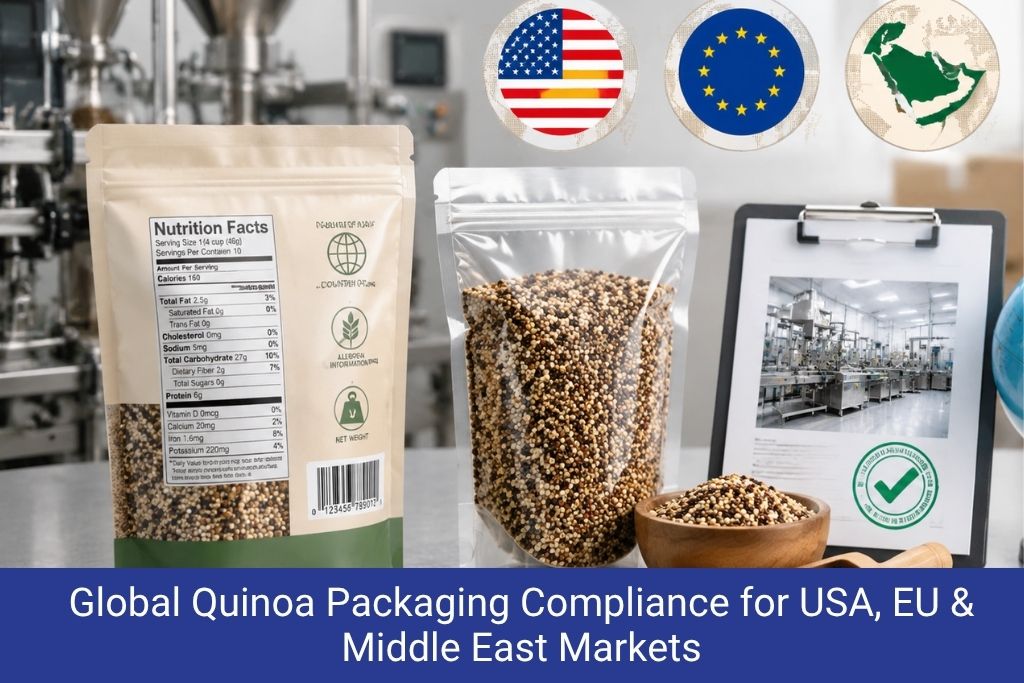
Packaging compliance varies significantly by destination market and must be addressed well before shipment.

For the USA market, quinoa seed packaging must carry full FDA-compliant nutritional labelling (per 21 CFR Part 101), country of origin, allergen declarations and net weight in US customary units. For quinoa seeds, buyers must ensure the manufacturer can provide FDA-registered facility documentation.

EU packaging requires compliance with EU Regulation 1169/2011 on food information to consumers, including mandatory nutritional declarations per 100g, EU organic logo (if applicable) and EU importer address on the label. Language requirements must also reflect the destination member state.

Middle East markets under GCC Standardisation Organisation (GSO) rules require Arabic labelling, HALAL status display, production and expiry dates in Hijri or Gregorian format and country of origin. Shelf life claims must align with the importing country’s food dating conventions.

Exporters offering custom or private label quinoa seeds should confirm their packaging capabilities against each destination market’s regulatory checklist before finalising purchase agreements.

Key Export Documentation Checklist for International Buyers

When sourcing from quinoa seed manufacturers in India, buyers should verify the following document set: FSSAI licence and export certificate, ISO 22000:2018 certificate, certificate of analysis (COA) from an accredited third-party lab, certificate of origin, packing list and commercial invoice and relevant organic or HALAL/KOSHER certificates where applicable.

Incomplete documentation is one of the most common causes of consignment delays at ports of entry in the EU and the USA. Buyers should establish documentation submission timelines with their supplier at the contract stage.

Get Your Custom Bulk Order Quote! Contact Us

WhatsApp

Conclusion

Exporting quinoa seeds from India to international markets is a compliance-intensive process that extends well beyond product quality. From ISO 22000:2018 and FSSAI licensing to market-specific packaging requirements, every layer of documentation directly affects market access and buyer trust. Giriraj Enterprise, as a certified quinoa seed manufacturer and exporter in India, operates with the full compliance infrastructure required to serve buyers across the USA, EU and Middle East – making it a reliable sourcing partner for importers, distributors and private label buyers seeking verified, regulation-ready supply.

FAQs

What certifications are mandatory for exporting quinoa seeds from India to the EU?

FSSAI licensing, ISO 22000:2018 and NPOP organic certification (if selling as organic) are the core requirements for EU market entry.

Is NPOP organic certification accepted in the USA?

No. NPOP is recognised as equivalent to EU Organic standards but is separate from USDA NOP. Exporters must hold NOP certification independently for US organic market access.

What does a certificate cover for quinoa seed export?

It certifies that the quinoa consignment is free from regulated quarantine pests and compliant with the importing country's plant health requirements.

Do private label quinoa seed manufacturers in India need FDA registration?

Yes, any facility exporting food products to the USA must register with the FDA under the Bioterrorism Act and comply with FSMA requirements.

<< 1 >>