






October 22, 2026
Mihir Shah
Share At:
Google AI ChatGPT Grok Perplexity
Ground Spices for Ready to Eat Meals

AI Summary

This guide helps ready meal, sauce and frozen food manufacturers evaluate ground spices against their own mixing systems and cooking processes, not just general flavour claims. It covers particle size, wet and dry dispersion, preblending, automated dosing, flavour reference standards and heat processing, closing with how to translate a successful trial into a repeatable supply specification.

Ground Spices for Ready to Eat Meals and the Manufacturing Process

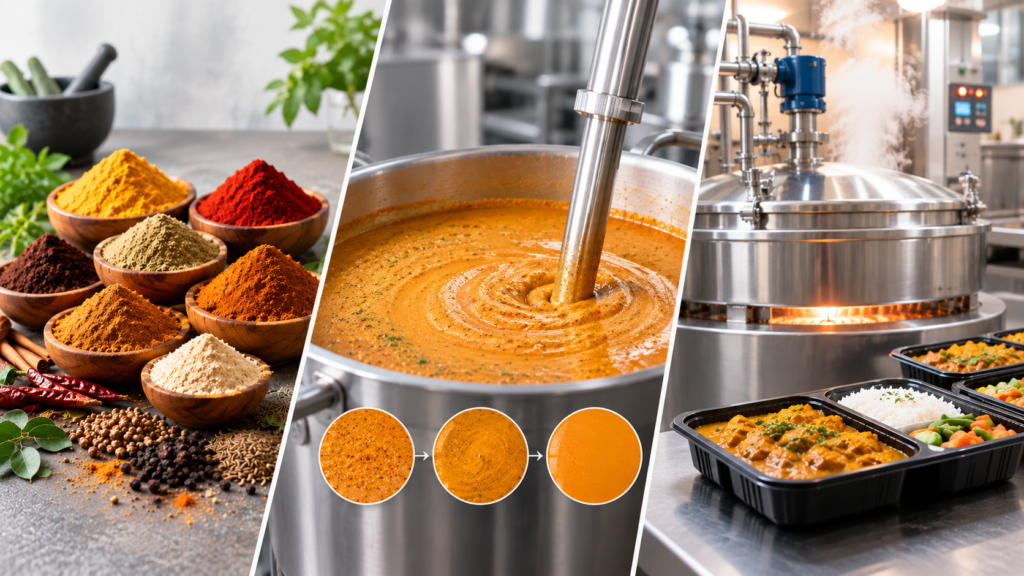
Achieving a consistent flavour and an even ingredient appearance in a commercially produced meal depends on more than the spice itself.

Selecting ground spices for ready to eat meals requires looking at the full formulation, the mixing process and the cooking conditions the product will go through.

The same powder can behave differently across different systems, which makes this one of the more practical areas of spices for food manufacturing.

The sections below work through each of these factors in turn.

Connect with Us for Export Deals! Contact Us

Message us on WhatsApp

WhatsApp

Contact us

Define the Application Before Selecting Ground Spices

Before approaching a ground spice supplier, define how the ingredient will enter the formulation and move through production.

When purchasing bulk seasoning ingredients, share the product type, mixing system, heat exposure and final appearance requirements so the proposed specification addresses the actual application.

Information worth communicating includes:

  1. Product type and intended flavour profile
  2. Whether the spice enters a wet formulation or a dry seasoning system
  3. Mixing equipment and the sequence in which ingredients are added
  4. Cooking or other heat exposure the product will undergo
  5. Relevant cooling, freezing, storage and reheating conditions
  6. Desired final appearance and texture

A sauce, a solid meal component and a dry seasoning mix each place different demands on a ground spice.

A specification that performs well in one of these systems should not be assumed to suit the others without separate evaluation.

Ground Spice Particle Size: Texture and Visibility

Particle size affects how a ground spice is seen and felt in the finished product.

Buyers typically assess it against what the product actually needs rather than aiming for the finest powder available.

A coarser grind may be preferred where visible flecks are part of the expected appearance.

A finer grind may suit a smooth sauce base.

Points worth defining with a ground spice supplier include:

  • Whether visible particles are wanted or should be minimised
  • How grittiness is perceived in the finished product, not only in the raw powder
  • How evenly particles of the agreed size are distributed through a sample
  • An agreed method for reporting particle size, since a single mesh number does not fully describe a material’s behaviour

Ground Spice Dispersion in Wet Systems

When industrial spice powder is added to a sauce, gravy or other wet formulation, the relevant question is how well it incorporates under the conditions the product will actually use.

This depends on where in the process the spice is added, how the mixing system operates and how much time is available for it to work through the batch.

Manufacturers typically evaluate:

  • The point in the process at which the spice is added
  • Mixing speed, shear and available mixing time
  • Visible signs such as clumping, floating particles or uneven colour distribution

Dispersion, meaning an even spread of particles through the liquid, is distinct from dissolution.

Ground spices disperse rather than fully dissolve.

No single addition method suits every wet system, and the checks above are best read against the specific formulation in question.

Ground Spice Distribution in Dry Seasoning Systems

In a dry seasoning mixture, the concern shifts from incorporation into a liquid to uniformity across the dry blend.

Ground spices often differ in particle size and density from other seasoning components, which can lead to separation during transfer, filling or vibration if not checked.

Relevant considerations include:

  • Differences in particle size between the spice and other blend components
  • Handling steps, such as transfer between vessels, that can encourage segregation
  • Sampling from more than one point in a batch, including the top, middle and discharge point, to assess whether distribution holds across the blend
Cumin Powder

Preblending Ground Spices Before the Main Batch

Some manufacturers introduce ground spices into the main batch directly, while others prepare an intermediate preblend first.

Whether this step is useful depends on the specific mixing or handling difficulty the formulation presents, rather than being a default step for every product.

Where a preblend is used, it is worth defining:

  1. Which ingredients are combined in the preblend
  2. How the preblend is identified and labelled through the process
  3. The sequence followed to prepare it
  4. How consistency of the preblend itself is checked before it enters the main batch

A preblend may help distribute ingredients used at low inclusion levels.

Assess its effect on blend uniformity, transfer losses and dust generation during trials rather than assuming it improves every handling characteristic.

Automated Dosing of Bulk Seasoning Ingredients

Where bulk seasoning ingredients pass through automated feeding or weighing systems, compatibility with that specific equipment is worth confirming directly rather than assumed from a particle size figure alone.

Flow behaviour can vary with humidity, equipment design and the condition of the powder over time.

Factors worth checking during a dosing trial include:

  • Flow behaviour through the feeder, including any tendency to bridge or arch
  • Dust generation during transfer and weighing
  • Repeatability of the dose across multiple cycles
  • Residual material left in the feeder or hopper after a run

Flavour Consistency in Spices for Food Manufacturing

Flavour consistency depends on having an agreed point of comparison, rather than relying on general descriptions.

Buyers typically assess an incoming batch of spice against a defined reference sample, prepared and evaluated the same way each time, so that any difference can be recorded in specific terms.

An approved sensory reference is worth defining through:

  • A consistent preparation method used for every comparison
  • A defined evaluation procedure, including how samples are presented and assessed
  • Recorded notes on specific differences, rather than general terms such as strong or premium

Assessing the incoming spice on its own is a separate step from evaluating it once incorporated into the finished meal.

Colour intensity should not be treated as a stand in for flavour strength, since natural ingredients vary between lots while remaining within specification.

Ground Spice Flavour During Heat Processing

How a ground spice performs before cooking does not necessarily predict how it performs after the product’s actual heat process.

Cooking duration, temperature profile and the point at which the spice is added can all influence the final flavour balance, so comparison before and after the intended cooking cycle is a useful step.

Worth comparing specifically:

  • Flavour and aroma before and after the cooking or reheating cycle used in production
  • Whether the timing of spice addition relative to heat exposure affects the result
  • Any shift in perceived intensity or balance once the product reaches its final form

Sensory performance under heat is a separate matter from microbial control, and evaluating flavour through a cooking cycle does not replace a manufacturer’s established food safety controls.

Batch Trials for Ground Spices in Production

Particle size, dispersion, dosing and heat processing are each worth checking individually.

Confirming a ground spice for production depends on running these together in a documented batch trial, rather than treating any single check as sufficient on its own.

This is where the practical decision to move forward with a spice is made.

A trial worth documenting typically records:

  • Distribution and appearance in the finished product
  • Flavour, assessed against the approved sensory reference
  • Texture and any visible particle characteristics
  • Process behaviour, including mixing and dosing observations
  • Where relevant to the product, assessment after cooling, freezing or reheating

Acceptance criteria are best agreed before the trial begins, so results can be judged against a fixed standard.

A successful small trial also does not automatically extend to a different production scale, and scale up is worth confirming separately.

Dill Seed

Ground Spice Repeat Supply Requirements

Once a trial has been approved, the practical step is recording exactly what was approved, so that repeat orders match it consistently.

This becomes the working reference for both the buyer and the ground spices manufacturer supplying the material.

A repeat supply record typically covers:

  1. Product identity and the approved specification
  2. Relevant particle size requirements
  3. The approved sensory reference and the conditions under which it was evaluated
  4. Batch identification and required quality documents
  5. Packaging and handling requirements
  6. How relevant changes will be communicated by the supplier
  7. The procedure for investigating a delivery that differs from the agreement

Keeping this record current is what allows routine purchasing to proceed without repeating the full evaluation each time.

It also forms the basis for meeting ground spices wholesale requirements as order volumes grow.

Get Your Custom Bulk Order Quote! Contact Us

Message us on WhatsApp

WhatsApp

Bulk Order

About Giriraj Enterprise: Ground Spices Manufacturer and Exporter

Giriraj Enterprise, based in Unjha, Gujarat, is a manufacturer, exporter and wholesale supplier of psyllium products, whole spices, ground spices and spice blends, herbal products, guar gum and other agro products, serving customers in India and overseas markets.

We offer private labelling and customised packaging across a range of spices and food products, supplying under customers’ own labels alongside our standard offering.

If you are evaluating ground spices for a ready to eat meal, sauce or seasoning application, we welcome you to share your application, required specification, quantity and packaging needs.

Conclusion

Selecting ground spices for ready to eat meals works best as an evaluation process grounded in the actual formulation, mixing system and cooking conditions a manufacturer uses, rather than a decision based on the raw ingredient alone.

Documented trials, appropriate scale assessment and agreed repeat supply requirements give buyers a practical basis for selecting and monitoring the ingredient.

FAQs on Ground Spices for Ready to Eat Meals

Do ground spices dissolve completely in sauces?

No. Ground spices disperse through a liquid formulation rather than dissolving fully. The relevant measure is even distribution without clumping or separation, which is best confirmed through a trial in the actual sauce system.

Is a finer spice powder always better for ready meals?

Not necessarily. The right particle size depends on the product's intended appearance and texture. A coarser grind may suit a product where visible flecks are expected, while a finer grind may suit a smooth base.

When should manufacturers evaluate a spice preblend?

A preblend may help distribute ingredients used at low inclusion levels. Its effect on blend uniformity, transfer losses and dust generation is best confirmed during trials rather than assumed, and it is not a default step for every formulation.

How can buyers assess flavour after heat processing?

By comparing the spice's flavour and aroma before and after the product's actual cooking or reheating cycle, using a consistent evaluation method, and noting any shift in intensity or balance once the product reaches its final form.

What should a repeat supply specification include?

It should record the approved product specification, particle size requirements, sensory reference, batch identification, quality documents, packaging and handling requirements, and the procedure for investigating any delivery that differs from what was agreed.

<< 1 >>