



AI Summary:
Whole spice authenticity testing combines defined identity requirements, representative sampling and suitable screening or laboratory methods. Visual inspection, colour and aroma checks can flag concerns, while microscopy or chemical fingerprinting may help investigate specific suspected substitutions. Buyers should interpret findings within the method’s scope and hold suspect material pending quality review.
Why Whole Spice Authenticity Testing Matters for Buyers
When a shipment of whole spices arrives, the material inside the bags does not always match what was ordered. A declared species may be substituted with a cheaper look alike, mixed with undeclared material, or contaminated with foreign seeds that were never part of the agreed specification.
Because whole spices retain much of their natural shape, buyers sometimes assume that visible structure is enough to confirm identity. This is not a safe assumption.
Whole spice authenticity testing exists precisely because physical form can survive substitution. Some closely related species or plant parts resemble the genuine product closely enough to pass a casual glance.
Importers, retail chains and food manufacturers sourcing authentic whole spices need clear identity requirements and evidence appropriate to the product. When assessing whole spices manufacturers in India, buyers should distinguish routine spice quality testing from a targeted authenticity investigation.
The evaluation should connect purchasing specifications, representative sampling and suitable laboratory methods.
Get Bulk Psyllium, Spices & Grains Quotes Today!



Defining Whole Spice Identity and Product Specification
Before any inspection or testing begins, buyers need a written reference point. Without one, there is nothing concrete to compare the shipment against, and any observation becomes a matter of opinion rather than verification.
A usable specification should record:
- The common product name used in the purchase agreement
- The botanical identity, where this matters for the product category
- The plant part being purchased, such as seed, fruit, bark or leaf
- The whole product form and the agreed grade
- Permitted extraneous matter and the acceptance criteria that apply
- The supporting documentation required from the supplier
Identity, commercial grade and overall quality are related but separate questions. A shipment can match the declared species yet still fall short on grade or cleanliness, and a well graded lot can still fail on identity if the wrong material was supplied.
Keeping these distinctions clear prevents a grading dispute from being mistaken for an authenticity concern, or the reverse.
Read Our Article
Organic vs Conventional Ground Spices: Production InsightsSpice Adulteration Detection: Substitution Risks in Whole Spices
Three different situations fall under the general concern of spice adulteration detection, and buyers benefit from treating them separately rather than as one problem.
Replacement occurs when the declared spice is substituted, in whole or in part, with a different material. Addition occurs when an undeclared substance is mixed into a genuine lot to increase weight or bulk. Incidental foreign matter is a separate category, where unrelated plant parts, dust or debris enter the lot through handling rather than deliberate action.
Foreign seeds, unfamiliar plant fragments or visually similar material are reasonable points to investigate further, but they are not evidence of intent on their own.
A buyer who finds unexpected material should treat it as a trigger for closer examination, not as proof of deliberate fraud by a particular supplier or origin.
Representative Sampling for Authentic Whole Spices
Any conclusion drawn from a shipment is only as reliable as the sample it was based on. A result from a handful of pieces picked because they looked unusual tells a buyer something about those specific pieces, not about the condition of the wider lot.
Sound sampling practice starts with clear lot identification, followed by drawing material from multiple locations or containers across that lot rather than a single point. Each sample should be labelled, preserved appropriately for the spice in question, and linked by record to the shipment it came from, so the result can be traced back later if needed.
It is worth distinguishing two different sampling purposes. A targeted sample, drawn to investigate specific suspicious pieces found during inspection, answers a narrow question about those pieces. A representative sample, drawn to characterise the lot as a whole, is what supports a broader conclusion about the shipment.
Agreed reference samples and sealed duplicate samples, held by both parties, can also support later discussions if a dispute arises.
No fixed sample quantity applies universally. The appropriate amount depends on the product, the lot size and the question being asked, and should be agreed with the testing laboratory.
Our Other Product
Whole SpicesVisual Inspection to Screen Whole Spices for Authenticity
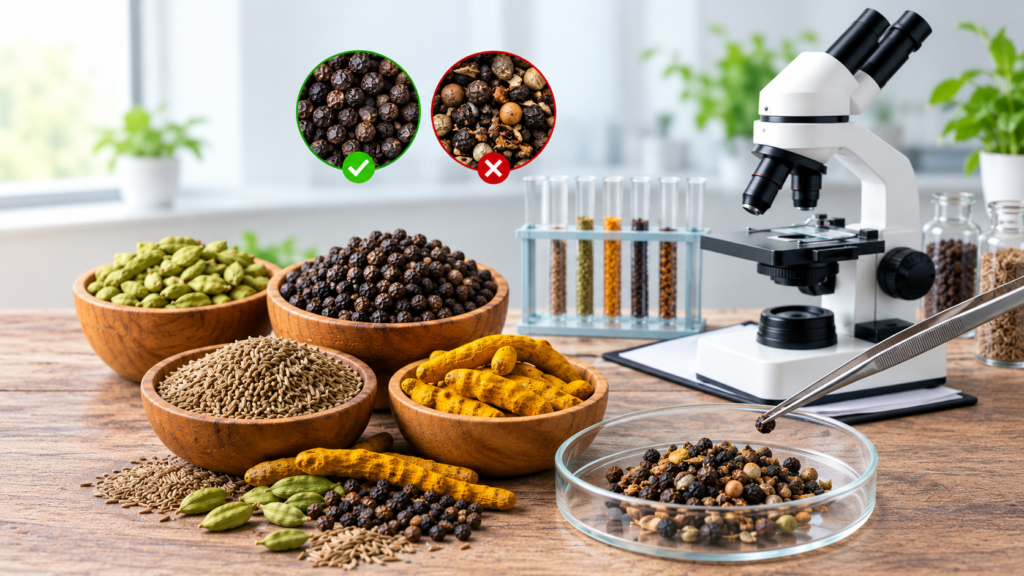
Visual inspection is a useful first screening step for whole spice authenticity testing, but it has clear limits. It works by comparing the material in hand against an authenticated reference sample and the agreed product description, not against general expectations of what the spice should look like.
Relevant characteristics to compare include shape, size, surface texture, visible plant structure and the presence of seeds or fragments that do not belong to the declared product. Photographing suspicious material alongside the reference sample, and recording where in the lot it was found, creates a documented basis for any follow up discussion with the supplier.
Visual inspection may miss material that closely resembles the declared spice or changes that are not visible externally.
Where inspection raises a genuine question that cannot be resolved by eye, it becomes the basis for requesting laboratory investigation rather than a final answer in itself.
Colour and Aroma Checks in Spice Quality Testing
Colour and aroma observations can support the screening process, but only when compared against an approved reference sample under consistent viewing and assessment conditions. Lighting, storage age and handling can all influence how a genuine spice looks or smells, independent of identity.
A departure from the expected colour or aroma profile is worth noting as a possible concern, but it should not be read as conclusive proof of substitution or adulteration. The same departure can also result from age, processing conditions or storage, which have nothing to do with authenticity.
For this reason, tasting suspect material is not a recommended screening method. Sensory observations are best treated as supporting evidence rather than a standalone conclusion.
Microscopy in Spice Adulteration Detection
Microscopy allows a laboratory to examine diagnostic plant structures that are not visible to the unaided eye, and it can help confirm or question an identity concern raised during earlier screening. Its usefulness depends heavily on the specific spice involved, the condition of the sample and the distinguishing structures available for comparison.
Before commissioning microscopic examination, buyers should ask the laboratory directly:
- Whether microscopy is a suitable method for the suspected identity question
- What authenticated reference material the comparison will be made against
- Which analyst or team will interpret the result, and their relevant experience
Microscopy does not identify every possible adulterant and does not establish intent behind a finding.
Ask the laboratory whether its microscopy method supports identification only or also an estimate of mixture composition. The report should state the method’s scope and limitations.
Chemical Fingerprinting and Spice Quality Testing Suitability
Chemical fingerprinting compares the chemical profile of a sample against reference data to help assess identity or detect certain forms of adulteration. Its value depends entirely on whether the method fits the specific question being asked, which makes a scoping conversation with the laboratory essential before testing begins.
Buyers should clarify the following before commissioning this type of spice quality testing:
- The specific substitution or adulteration under suspicion
- Whether the proposed method is suitable for that spice and that question
- The reference materials or comparison data the laboratory will use
- Factors, such as origin or processing, that may affect how results are interpreted
- What the result can establish, and what it cannot
An unusual chemical profile is a reason for further enquiry, not automatic proof of fraud.
Buyers should expect the laboratory to explain the method and its scope rather than accept a pass or fail answer without context, and should be cautious of any claim involving a specific marker compound, instrument or detection limit that has not been confirmed by the testing laboratory itself.
Our Other Product
Senna LeavesCommissioning Independent Spice Quality Testing
A laboratory can only investigate what it is asked to investigate. A useful testing brief states the declared identity, relevant lot details, the specific concern observed during screening, the applicable specification and the decision the result needs to support.
Before sending samples, it is worth confirming the laboratory’s competence and scope for the relevant test, its sample handling requirements, the format the report will take and the stated limitations of the method used.
Routine spice quality testing, run as a general compliance check, is different from a targeted authenticity investigation aimed at a specific suspected substitution. A standard panel is not automatically designed to detect every form of adulteration, and buyers should confirm which question a given test is actually answering.
Interpreting Spice Quality Testing Results and Lot Disposition
Once results arrive, the quality team’s task is to compare them against the agreed specification and understand exactly what the testing method covered. Review whether the findings support conformity, identify a nonconformity or remain inconclusive within the scope tested.
A result for one suspected adulterant does not establish authenticity against every other possible concern.
Suspect material should be held pending review as soon as a concern is raised during screening, rather than released while the question remains open.
Once results arrive, the appropriate next steps include documenting the discrepancy in detail, confirming or releasing the hold on affected material, communicating findings to the supplier for response, and obtaining a formal disposition decision from an authorised person.
Repeated testing should never be used simply as a way of obtaining a passing result rather than resolving a genuine concern.
Get Bulk Psyllium, Spices & Grains Quotes Today!
Authenticity Requirements for Whole Spices Suppliers and Exporters
Authenticity expectations work best when they are written into the purchasing agreement rather than raised only after a problem appears. This includes identity requirements, sampling expectations at the point of shipment, documentation to be supplied and the procedure to follow if a discrepancy is found.
For export orders, wholesale purchasing and private label whole spices, these expectations should be agreed with suppliers and manufacturers in advance, covering what documentation accompanies each shipment and how any dispute over identity will be resolved.
About Giriraj Enterprise as a Whole Spices Supplier
Giriraj Enterprise, based in Unjha, Gujarat, India, offers psyllium seeds, husk, husk powder and kha kha powder, whole and ground spices, herbal products, guar gum, chia seeds, quinoa and other agro products. We serve wholesale and export buyers, with private labelling, contract manufacturing and customised packaging options. Contact our team to discuss spice identity, specifications, documentation and order requirements.
Conclusion: Applying Whole Spice Authenticity Testing
Whole spice authenticity testing should address a clearly defined identity or adulteration concern. Representative samples and suitable methods give buyers a stronger basis for assessing the supplied lot. Review findings against the purchase specification, clarify inconclusive results with the laboratory and document the quality decision before releasing suspect material. Agreeing on these requirements with suppliers helps make future purchasing decisions more consistent.
FAQs About Whole Spice Authenticity Testing
Can visual inspection confirm whole spice authenticity?
Visual inspection can flag material that does not match the reference sample or product description, but it cannot reliably distinguish closely resembling species or detect concealed adulteration. It is a screening step, not a final confirmation.
How does substitution differ from incidental foreign matter?
Substitution means replacing some or all of the declared spice with another material. Incidental foreign matter is unintended material introduced during harvesting, processing or handling. An unexpected finding requires investigation before its cause or intent can be established.
Why is representative sampling important for authenticity testing?
A result is only as reliable as the sample behind it. Sampling drawn from multiple points across the lot, rather than a few selected pieces, is needed to support conclusions about the shipment as a whole.
Can a routine spice quality report detect every adulterant?
No. A standard quality panel is designed for general compliance checks and is not automatically built to detect every possible form of substitution or adulteration. A targeted investigation needs its own scope.
What should buyers do when laboratory results are inconclusive?
An inconclusive result should be documented and discussed with the laboratory to understand what the method could and could not establish, rather than treated as either a pass or a fail. Further targeted testing may be needed to resolve the specific concern.

Mihir Shah is the CEO of Giriraj Enterprise, a trusted manufacturer, supplier, and exporter of Psyllium products, whole spices, ground spices, herbal products, guar gum and other agro products like Quinoa Seeds, Chia Seeds including Isabgol, Plantago ovata Seeds, Ispaghula Husk Powder and Kha Kha Powder. Founded in 1973 and based in Unjha, Gujarat, Giriraj Enterprise has grown significantly under Mihir’s leadership, establishing itself as a trusted name in the global market. With a focus on high-quality standards and adherence to international food norms, the company serves a wide customer base across the globe.
A strategic thinker with a passion for sustainable growth, Mihir has played a pivotal role in expanding the company’s production capacity, which now stands at 3,000 quintals per month, and in ensuring that Giriraj Enterprise remains at the forefront of innovation in the industry. His commitment to quality is reflected in the company’s stringent in-house quality testing and third-party verification, ensuring that all products meet the highest standards of excellence. He is dedicated to driving customer satisfaction by offering fast, reliable services both domestically and internationally.
Through his writing, Mihir shares valuable insights and knowledge about Psyllium, spices, herbal and other agro products, educating readers on their benefits and the role they play in promoting health and well-being. His goal is to provide factual, transparent information to help consumers and businesses make informed decisions.