





AI Summary
Bulk chia seed storage requires dry conditions, suitable packaging and controlled handling from receipt to dispatch. Buyers should follow supplier storage instructions, monitor packaging condition and rotate stock according to declared shelf life. Opened bags need separate tracking, while moisture exposure, unusual odours or pest evidence require quality review. Storage records help teams investigate changes and make informed decisions about affected lots.
Chia Seed Storage Requirements for Bulk Buyers
Chia seed storage requires clear controls from the moment a bulk shipment reaches the warehouse. Receiving teams need to establish the condition of each lot, record the supplier’s instructions and identify any transport damage before accepting stock.
These records provide a reference for investigating changes during storage. For importers, wholesalers and food manufacturers, the priority is preserving the supplied quality until production, repacking or dispatch.
Bulk chia seed shelf life should be managed against the supplier’s declared date and approved storage conditions. Effective warehouse storage for chia seeds covers:
- Preventing moisture entry
- Selecting an appropriate storage location
- Controlling handling after opening
- Managing chia seed oxidation through exposure and packaging suitability
- Assigning responsibility for monitoring, stock rotation and decisions on suspect material
Bulk Chia Seed Receiving Checks
Incoming inspection sets the baseline every later storage decision depends on. When a bulk shipment is unloaded, the receiving team should:
- Confirm the lot number or batch identification against the supplier’s documentation
- Check that supplier storage instructions and the remaining declared shelf life are recorded
- Verify any certification documents required for the order
Packaging condition should be checked bag by bag where volumes allow, or by representative sampling for larger consignments. Signs of transport exposure include:
- Condensation inside the outer wrapping
- A damp pallet base
- An odour different from an appropriately stored retained sample, where available
This matters most for high volume chia seed wholesale orders, where even a small share of damaged stock affects the usable quantity from a consignment.
Chia Seed Storage Moisture Controls
Moisture exposure requires specific warehouse controls, including leak prevention, dry storage positions and procedures for investigating damp packaging. Before stock is placed, check for:
- Roof or pipe leaks
- Moisture seepage through walls
- Proximity to washdown zones or drains
Chia seed storage should not share space with wet processing areas.
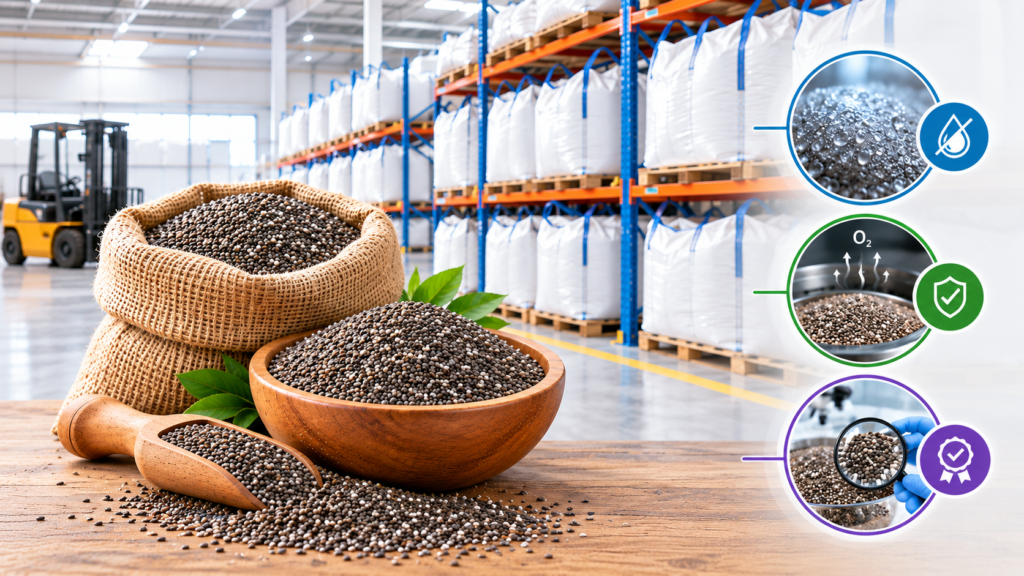
Bags and FIBCs should be kept off the floor on pallets. Avoid stacking directly against exterior walls, where temperature differences can cause condensation inside packaging. Leave gaps between pallets and walls for airflow.
Avoid storing chia seeds directly beneath overhead pipework or HVAC condensate lines, which are common sources of unexpected moisture.
If a warehouse team finds damp packaging, moisture staining, or unusual clumping within a bag, treat it as a warning sign requiring investigation. Route it through the inspection process described later in this article.
Packaging Requirements for Bulk Chia Seeds
Packaging protection should be checked against what has been specified and confirmed for the order, not assumed from appearance alone. Many bulk bags use an inner liner in addition to an outer woven or multi wall layer.
A liner that has shifted, torn, or was not fully resealed can leave seeds exposed even when the outer packaging looks intact. Both layers need a visual check whenever stock is moved, restacked, or pulled for an order.
Confirm the complete packaging specification with the supplier, including the protection provided by the liner and outer bag.
- Check that the supplied format is suitable for the intended storage period and handling conditions
- Where these details are missing from the order documentation, request clarification before planning extended storage
Temperature and Light in Chia Seed Storage
Storage location affects chia seed quality over time, even when packaging and moisture controls are in place. Keep bulk stock away from direct heat sources, such as:
- Boiler rooms
- Loading dock doors in hot weather
- Equipment that generates heat during operation
Sustained warmth accelerates quality loss in stored seeds.
Direct sunlight through windows, skylights, or open dock doors should also be avoided, particularly for stock stored near perimeter walls.
Where storage areas cannot fully avoid light or temperature variation, limit how long any pallet remains in an exposed position. Temperature fluctuations between a warm daytime warehouse and a cooler overnight environment are closely linked to the moisture risks described earlier.
Our Other Product
Fenugreek SeedChia Seed Oxidation and Quality Assessment
Chia seed oxidation is a chemical process driven primarily by oxygen exposure. It progresses faster the longer seeds are exposed and the warmer the surrounding environment.
An unusual or rancid smelling odour from stored chia seeds is a warning sign that should prompt investigation rather than be dismissed as normal variation between lots. Compare it against an appropriately stored retained sample, where available, and record the finding.
It is important not to treat appearance or smell as a reliable test for food safety or for how much shelf life remains. A visual or odour check can flag a lot for closer review, but confirming fitness for use requires a quality assessment beyond what warehouse staff can determine by inspection alone.
Warehouse Storage for Chia Seeds: Hygiene and Pest Control
General warehouse hygiene reduces the risk of pest activity and contamination around stored chia seeds.
- Clean up spilled seed promptly, since residue can attract pests and hide a developing leak or torn bag
- Inspect around and beneath pallets regularly for droppings, gnaw marks, or insect activity, not just the visible top of a stack
- Keep pest monitoring stations in place as part of the facility’s standard programme
Log findings so activity near chia seed storage can be tracked over time rather than noticed only once it becomes a visible problem.
Store chia seeds away from strong smelling materials, such as cleaning chemicals or solvents, since dry seeds can absorb surrounding smells over time. Segregating food grade stock from non food materials in the warehouse layout is a straightforward way to reduce this risk.
Opened Chia Seed Handling and Private Label Repacking
Once a bulk bag is opened for production use or repacking, handling practices determine how much protection the remaining stock keeps.
Open bags in a controlled area away from washdown zones or damp surfaces, using clean, dry tools. A torn liner or a scoop carried in from a wet area can introduce moisture at the point it matters most.
Reseal the original packaging promptly after the required quantity is removed, rather than leaving a bag open while other tasks are completed. If the original packaging cannot be securely resealed:
- Use a suitable food grade container or replacement packaging approved by your quality team
- Preserve the original lot identification
- Record the transfer
Record the date a bag was opened and the batch or lot identification. Follow the supplier’s guidance on handling after opening where this is provided.
For repacking chia seeds into private label retail packs, the same controls apply:
- Controlled opening
- Dry tools
- Batch traceability carried through onto the new packaging
- Any supplier instructions specific to the repacking process
Bulk Chia Seed Shelf Life and Stock Rotation
Stock rotation should follow a first expired, first out approach, where the bag or lot with the nearest best before or expiry date is used first, regardless of when it physically arrived at the warehouse.
This depends on expiry or best before information being visible at the point of picking, not buried inside a pallet or recorded only in a system that floor staff cannot check quickly.
Track opened stock separately and assign its use priority according to:
- Remaining declared shelf life
- Any approved period after opening
- The quality team’s assessment
The declared shelf life on unopened, sealed packaging reflects the supplier’s storage conditions and packaging integrity staying intact. After opening, follow any approved use period and handling instructions. Keep the original declared date on record, and do not assign a later date simply because the stock has been resealed.
Our Other Product
Coriander SeedChia Seed Storage Records and Suspect Stock
Buyers should keep a consistent record for each lot, covering:
- Lot identification
- Storage location
- Supplier instructions
- Inspection dates
- Opening dates
- Declared shelf life
- Packaging transfers
- Quality release status
Warehouse monitoring limits and corrective actions should follow the approved product specification and facility procedures. Periodic warehouse inspections confirm that stock already in storage still matches the condition recorded at intake. A practical inspection checklist for chia seed storage should cover:
- Packaging condition, including punctures, torn seams, loose closures, or liner damage
- Signs of water exposure, including staining, condensation, or damp pallet bases
- Odour or appearance changes compared with an appropriately stored retained sample
- Evidence of pest activity in or around the storage area
- Traceability, including lot or batch labelling still legible and matching warehouse records
Any lot that fails one or more of these checks should be physically segregated from saleable stock, clearly labelled as under review, and recorded with the date, the finding, and who identified it. This creates a traceable record rather than relying on memory if the stock is queried later.
Segregated stock should go through a quality review before any decision is made on release, rework, or disposal. Warehouse staff should not make that call based on inspection alone.
About Giriraj Enterprise and Chia Seed Supply
Giriraj Enterprise, based in Unjha, Gujarat, offers chia seeds alongside psyllium, spices, herbal products and other agricultural products. The company also provides private labelling and customised packaging services.
Buyers can discuss their product and packing requirements with the team before ordering.
Conclusion: Managing Chia Seed Storage
Effective chia seed storage depends on clear responsibilities and consistent warehouse procedures. Use approved product specifications to guide storage conditions, handling and stock rotation.
Maintain records that connect each lot with its inspection history and release status. When conditions change or quality concerns arise, refer the affected stock for assessment before use. This approach supports informed inventory decisions throughout storage, production and dispatch.
Chia Seed Storage FAQs
How often should bulk chia seed stock be inspected in storage?
Inspection frequency should follow your facility's own quality procedures and the supplier's storage guidance. As a general practice, stock is checked at intake and then periodically as part of routine warehouse inspections, with any damaged or suspect stock reviewed immediately rather than waiting for a scheduled check.
Can chia seeds be stored in a refrigerator to extend shelf life?
Follow the storage conditions approved for the supplied product and packaging. If refrigeration is being considered, confirm the handling procedure with the supplier or quality team, including how condensation will be controlled.
What causes clumping in bulk chia seed storage?
Clumping should be treated as a possible sign of moisture exposure and investigated, with the affected bags isolated for a quality check.
Does this storage guidance apply to ground or hydrated chia seeds?
No. This guidance covers whole, dry chia seeds. Ground or hydrated chia products have different moisture content and handling needs, so confirm separate storage guidance for those forms with your supplier.
Mihir Shah is the CEO of Giriraj Enterprise, a trusted manufacturer, supplier, and exporter of Psyllium products, whole spices, ground spices, herbal products, guar gum and other agro products like Quinoa Seeds, Chia Seeds including Isabgol, Plantago ovata Seeds, Ispaghula Husk Powder and Kha Kha Powder. Founded in 1973 and based in Unjha, Gujarat, Giriraj Enterprise has grown significantly under Mihir’s leadership, establishing itself as a trusted name in the global market. With a focus on high-quality standards and adherence to international food norms, the company serves a wide customer base across the globe.
A strategic thinker with a passion for sustainable growth, Mihir has played a pivotal role in expanding the company’s production capacity, which now stands at 3,000 quintals per month, and in ensuring that Giriraj Enterprise remains at the forefront of innovation in the industry. His commitment to quality is reflected in the company’s stringent in-house quality testing and third-party verification, ensuring that all products meet the highest standards of excellence. He is dedicated to driving customer satisfaction by offering fast, reliable services both domestically and internationally.
Through his writing, Mihir shares valuable insights and knowledge about Psyllium, spices, herbal and other agro products, educating readers on their benefits and the role they play in promoting health and well-being. His goal is to provide factual, transparent information to help consumers and businesses make informed decisions.