




May 5, 2026
Mihir Shah
Share At:
Google AI ChatGPT Grok Perplexity

AI Summary

India is quietly building a domestic quinoa cultivation ecosystem across Rajasthan, Himachal Pradesh and Uttarakhand. While South America still dominates global supply, Indian-grown quinoa is gaining traction among buyers for its competitive pricing, improving yields and shorter supply chains. This article explores state-wise cultivation trends, yield benchmarks, what this shift means for quinoa seed suppliers and exporters and why companies are well-positioned in this evolving market.

Quinoa Seed Cultivation in India: The Market Shift Buyers Need to Know

For years, quinoa seed in India was almost entirely imported – sourced from Peru, Bolivia and Ecuador, then redistributed through domestic traders. That supply model is undergoing a quiet but significant transformation.

Indian agri-research institutions, state governments and private agri-businesses have spent the better part of a decade trialling quinoa across multiple climatic zones. The result is a steadily emerging domestic cultivation base concentrated in three states: Rajasthan, Himachal Pradesh and Uttarakhand.

For international buyers, private label brands and bulk procurement teams, this matters. A domestically produced quinoa supply means shorter lead times, lower freight-linked price volatility and a growing pool of quinoa seed manufacturers and suppliers operating within India’s regulatory and export framework.

Global quinoa demand currently exceeds 180,000 metric tonnes annually. South America controls roughly 80% of that supply. India’s share remains small but is growing – and the agronomic case for expansion is strong.

Connect with Us for Export Deals! Contact Us

WhatsApp

Quinoa Seeds in Rajasthan: Dryland Farming Potential and Yield Data

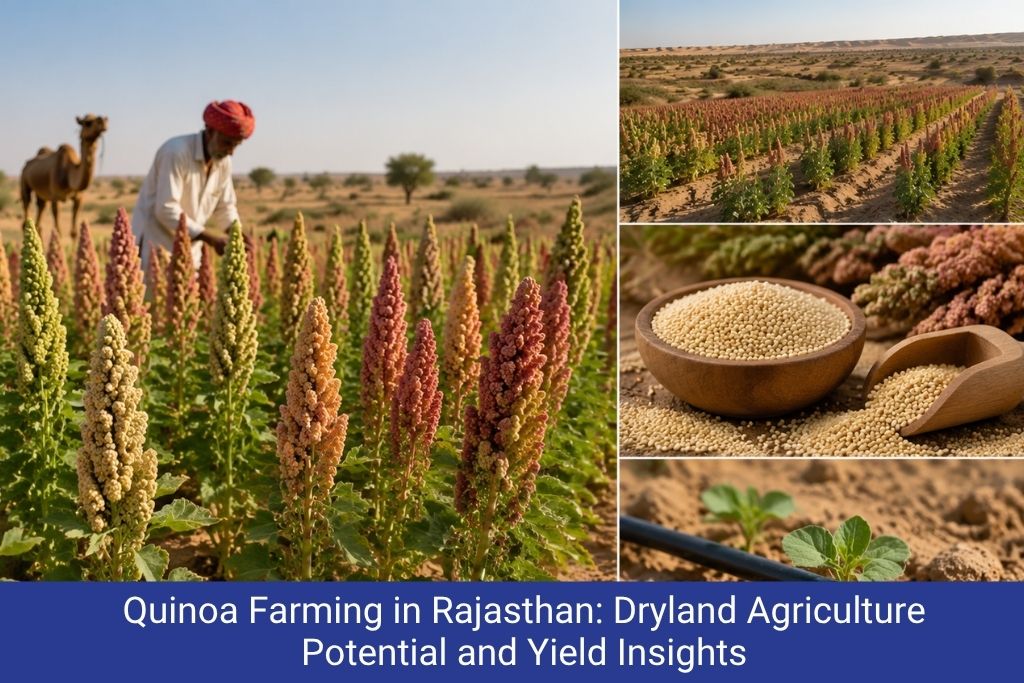
Rajasthan is the state generating the most interest among quinoa seed suppliers and commercial farmers. Its arid and semi-arid belts – particularly Barmer, Bikaner, Jaisalmer and Nagaur – present growing conditions that quinoa handles better than most food crops.

The crop tolerates saline and alkaline soils, requires relatively low water inputs compared to wheat or rice and fits naturally into dryland farming systems. ICAR-led field trials across Rajasthan have recorded yields ranging from 1,500 to 2,200 kg per hectare under managed inputs and appropriate variety selection.

Compared to Peruvian highland quinoa yields, which average between 1,200 and 1,800 kg per hectare under traditional farming, Rajasthan’s irrigated plots are showing competitive numbers. The quality parameters – protein content, saponin levels and grain size – are also increasingly meeting export standards.

For buyers sourcing quinoa seeds from India, Rajasthan-origin produce is beginning to enter both domestic health food supply chains and export documentation pipelines, through similar agri-export firms operating in the western India corridor.

Quinoa Seed Suppliers in Himachal Pradesh: High-Altitude Advantage Over South American Origins

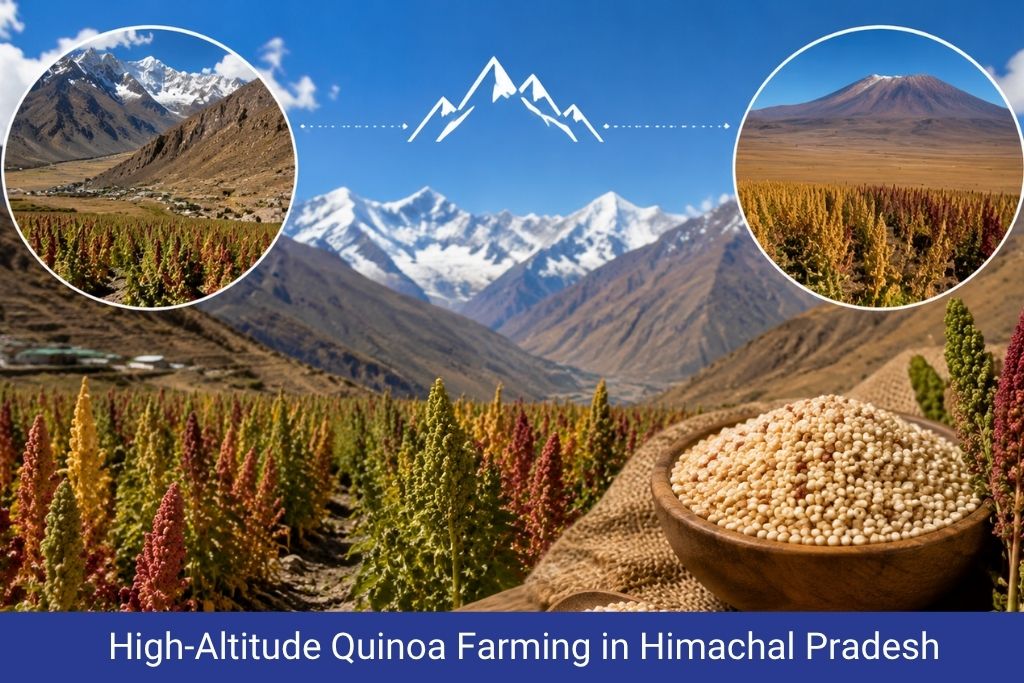
Himachal Pradesh offers a different cultivation profile. Districts like Lahaul-Spiti, Kinnaur and parts of Kullu sit at altitudes between 2,500 and 4,500 metres – a range that closely mirrors the Bolivian Altiplano, where quinoa has been farmed for centuries.

This altitude advantage is not trivial. Quinoa grown at higher elevations tends to develop smaller, denser grains with slightly higher protein concentration – a characteristic that commands premium pricing in European and North American specialty food markets.

State-level support through Himachal Pradesh’s Department of Agriculture has facilitated seed distribution, farmer training and trial plot establishment. Quinoa seed manufacturers who source from this region are increasingly able to offer altitude-certified and traceable produce – a differentiator that matters to organic and premium buyers.

Yield figures from Himachal Pradesh trials range from 800 to 1,400 kg per hectare, lower than Rajasthan but consistent with the high-altitude, low-input farming context. The trade-off in volume is partially offset by quality premium potential.

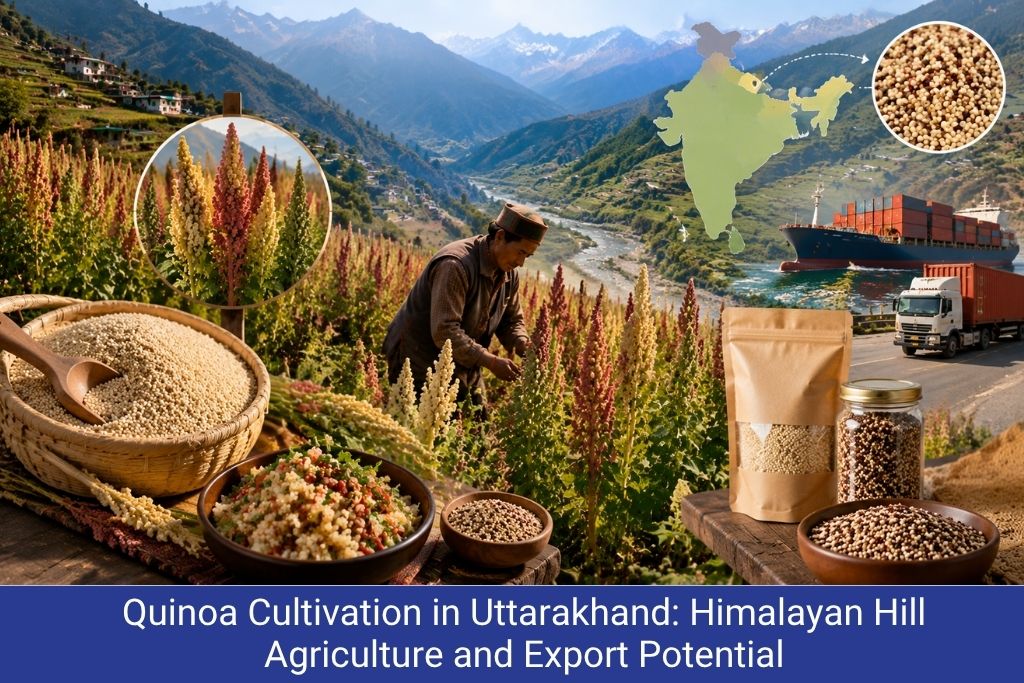
Quinoa Seeds in Uttarakhand: Hill Agriculture Revival and Emerging Export Pipelines

Uttarakhand’s Garhwal and Kumaon divisions present a third cultivation corridor, one that the state government has actively promoted under hill agriculture diversification programmes.

Quinoa fits well into Uttarakhand’s agricultural challenges: farmers here deal with fragmented land holdings, water scarcity in certain belts and limited viability for high-input commercial crops. Quinoa’s low input requirements, combined with its export value, make it an economically rational choice for smallholder farmers.

Yield data from Uttarakhand is still maturing, with early-stage trials showing 900 to 1,600 kg per hectare depending on variety and elevation. Several NGO-backed farmer producer organisations have been involved in aggregating output from small plots to create commercially viable lots for quinoa seed exporters.

For private label quinoa seed buyers, Uttarakhand-origin produce is beginning to appear as a traceable, story-rich sourcing option – particularly for brands targeting the clean-label and regional-origin market segments in Europe and the Gulf.

Quinoa Seed Exporters in India: How Domestic Production Is Reshaping the Supply Chain

The emergence of domestic cultivation directly impacts how quinoa seed exporters in India operate. Previously, most export activity involved re-export or value-added processing of imported Bolivian or Peruvian quinoa – cleaning, grading, repackaging and labelling under Indian export documentation.

With domestic cultivation scaling up, Giriraj Enterprise, as a reliable quinoa seed exporters are increasingly able to offer farm-traceable, India-origin quinoa seeds to international buyers. This matters for buyers who require origin certification and shorter logistics chains from source to port.

India’s key export destinations for quinoa include the UAE, the United States, the United Kingdom and Germany – markets where demand for plant-based protein sources continues to grow. Indian quinoa seed exporters are also finding traction in Southeast Asian markets, where quinoa is entering mainstream retail.

The pricing dynamic is also shifting. India-origin quinoa, particularly from Rajasthan, is entering the market at price points that are 8–15% lower than equivalent South American origins once freight and import duties are factored into landed cost calculations.

Get Your Custom Bulk Order Quote! Contact Us

WhatsApp

Conclusion

India’s transition from a quinoa-importing nation to an emerging cultivation and export hub is well underway, driven by favourable agro-climatic zones across Rajasthan, Himachal Pradesh and Uttarakhand. As domestic yields improve and private label infrastructure matures, India is positioned to capture a meaningful share of the global quinoa supply chain in the years ahead.

FAQs

Is quinoa commercially grown in India or only imported?

India now has active commercial cultivation in Rajasthan, Himachal Pradesh and Uttarakhand, though South American imports still supplement domestic supply for larger volume requirements.

India-origin quinoa meets comparable protein and saponin benchmarks, with high-altitude Himachal Pradesh varieties showing quality profiles similar to Bolivian highland origins.

Yes – Giriraj Enterprise offer private label quinoa seed solutions with custom packaging organic certification support and full export documentation.

Rajasthan currently leads on volume yields, while Himachal Pradesh offers premium quality from high-altitude cultivation zones.

Yes – Indian exporters with NPOP or USDA NOP organic certification can supply to EU and US markets.