





AI Summary
Plantago ovata and Plantago psyllium are two botanically distinct species within the same genus, yet they differ significantly in husk yield, mucilage content, swelling capacity and global trade relevance. While both produce psyllium seeds and husks used in the dietary fibre industry, Plantago ovata – commonly known as blond psyllium – dominates international commercial supply due to its superior husk-to-seed ratio and pharmacopoeial compliance. This article provides a structured scientific and commercial comparison between the two species to help buyers, formulators and traders make informed sourcing decisions.
Plantago Ovata and Plantago Psyllium - Botanical Identity and Species Origin
Plantago ovata, commonly referred to as blond psyllium or isabgol, is an annual herb native to the Indian subcontinent and parts of the Mediterranean region. Plantago psyllium – also called black psyllium or Spanish psyllium – is a separate species primarily grown in Spain, France and parts of Southern Europe.
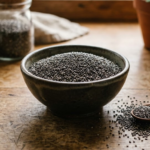
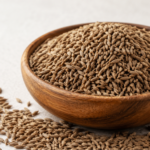
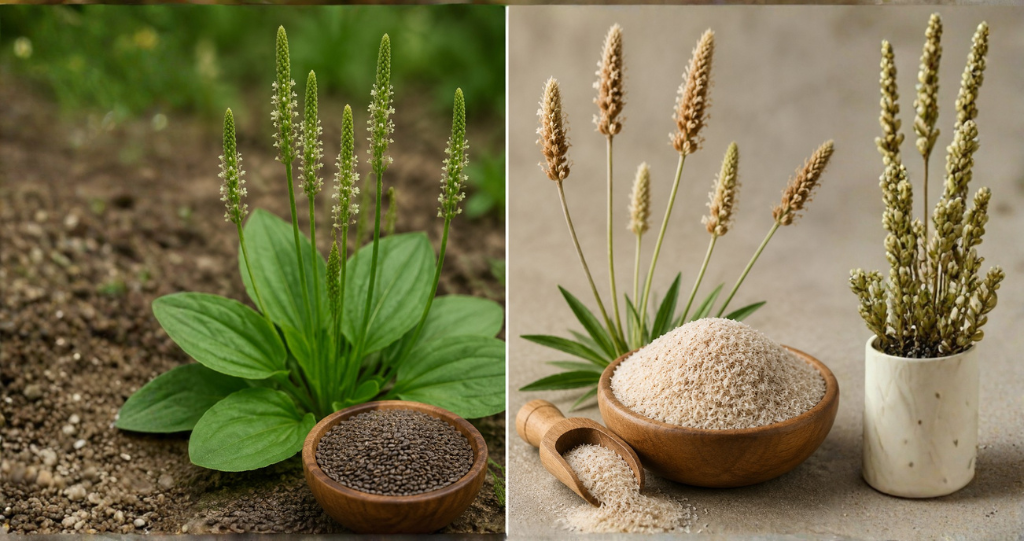
Both belong to the Plantaginaceae family, but they diverge considerably in morphology. Plantago ovata has pale, boat-shaped seeds with a translucent husk, while Plantago psyllium produces darker, smaller seeds enclosed in a comparatively thinner, less mucilaginous seed coat.
Understanding this species-level distinction is foundational before comparing their commercial and pharmacological profiles.
Export-Ready Psyllium, Spices & Grains Await! Contact Now
Psyllium Seeds - Structural Differences between the Two Species
The seed structure of each species directly determines husk extractability and end-use functionality.
Plantago ovata seeds are larger, roughly 2–3 mm in length, with a seed coat (husk) that contributes approximately 25–30% of the total seed weight. This husk layer is rich in arabinoxylan polymers responsible for gel-forming properties upon hydration.
Plantago psyllium seeds are darker in colour, slightly smaller and yield a husk that constitutes only around 10–15% of total seed weight. The lower husk-to-seed ratio in Plantago psyllium limits its commercial viability for large-scale husk extraction.
This structural contrast is one of the primary reasons the global psyllium trade overwhelmingly favours plantago ovata seeds as the raw material of choice for downstream processing.
Psyllium Husk vs Psyllium Plantago - Clarifying the Commercial Terminology
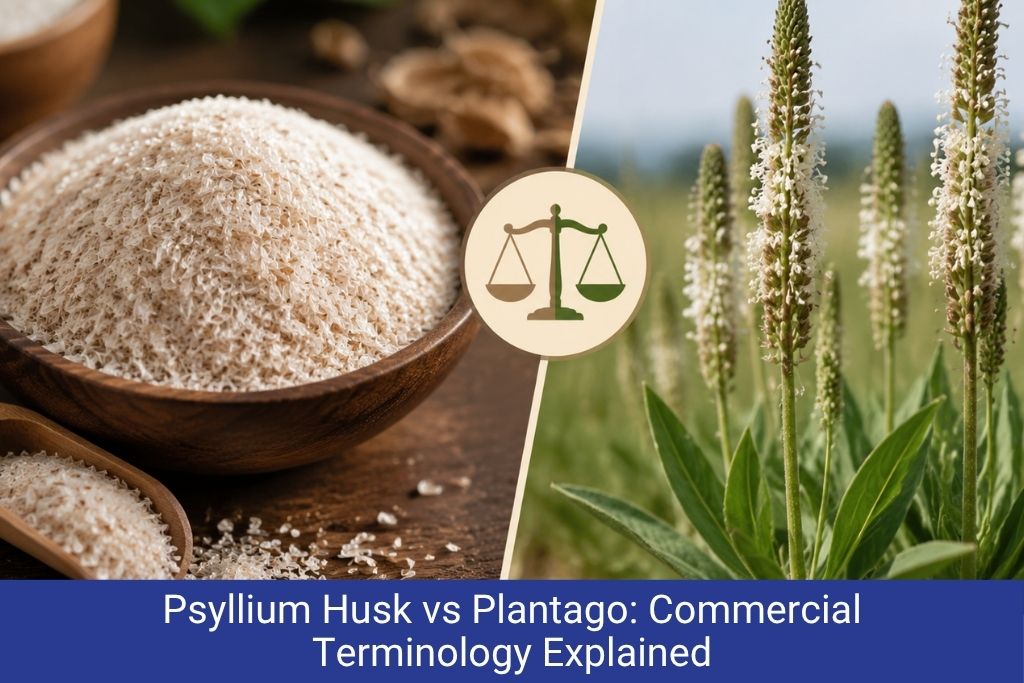
A common source of confusion in procurement and formulation circles is the interchangeable use of terms like “psyllium husk vs psyllium plantago” when they actually refer to different things.
“Psyllium husk” typically refers to the refined seed coat obtained from Plantago ovata, standardised to contain not less than 85% mucilage content as per major pharmacopoeias. “Psyllium plantago” in trade contexts often denotes either the whole seed or seed coat derived from Plantago psyllium, with no globally standardised mucilage benchmark.
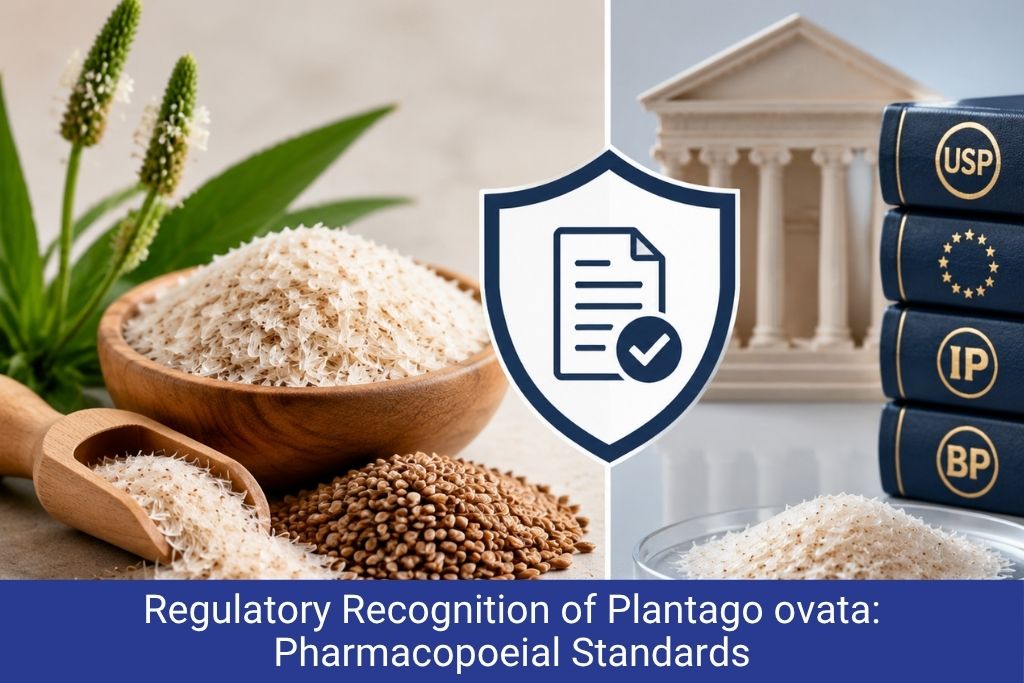
The distinction matters significantly in regulated markets – the European Pharmacopoeia (Ph. Eur.), the United States Pharmacopeia (USP) and the Indian Pharmacopoeia (IP) all list Plantago ovata husk and Plantago ovata seeds as official monographs, while Plantago psyllium has limited or no equivalent monograph status in most major pharmacopoeias.
Plantago Ovata Husk - Swelling Factor, Mucilage Yield and Pharmacopoeial Benchmarks
Plantago ovata husk is evaluated under rigorous pharmacopoeial standards that define its quality for pharmaceutical and nutraceutical use.
The swelling factor – a critical measure of hydrophilic capacity – for Plantago ovata husk must be not less than 40 (Ph. Eur. method), meaning 1 g of husk must form a gel volume of at least 40 mL when hydrated under standardised conditions. High-grade commercial batches often achieve swelling factors between 45 and 55.
Mucilage content (arabinoxylan fraction) in plantago ovata husk typically ranges from 20–30% of dry weight, with soluble fibre content exceeding 70% in refined grades.
Plantago psyllium husk, by contrast, exhibits a swelling factor of roughly 10–25, which falls short of the Ph. Eur. threshold required for pharmaceutical-grade classification. This lower swelling capacity limits its application in drug formulations, laxative products and FDA-regulated dietary supplements.
Our Other Product
Psyllium Husk (Isabgol)Plantago Ovata Seeds - Agricultural Production and India's Global Dominance
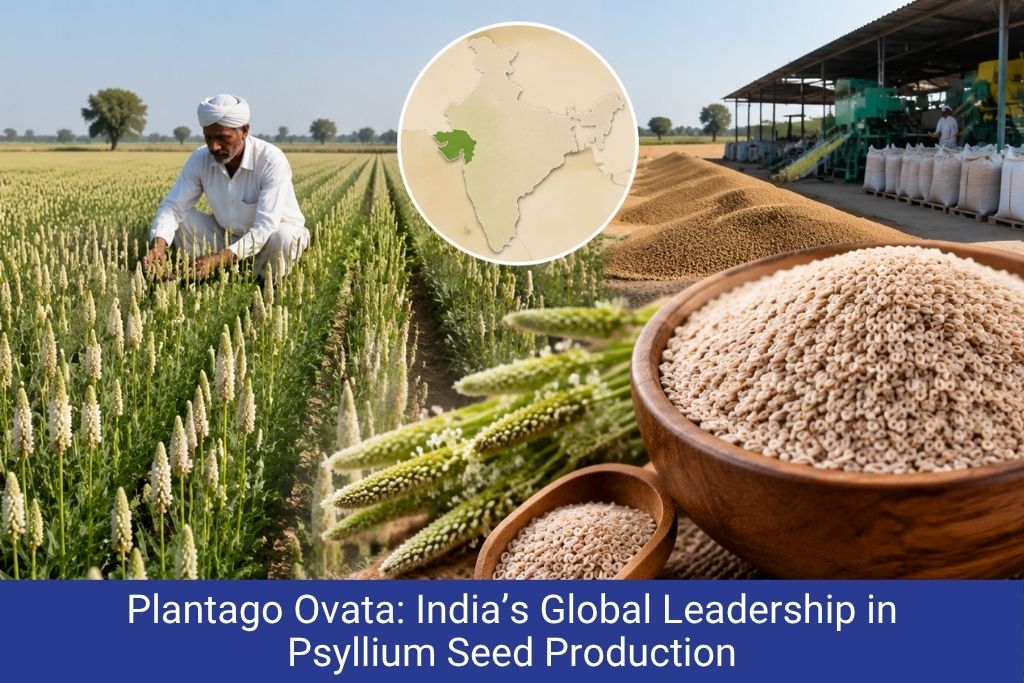
India accounts for approximately 85–90% of global Plantago ovata seed production, with the state of Gujarat being the primary cultivation and processing hub. The crop thrives in semi-arid, sandy loam soils and is predominantly grown in the Rabi season (October to February).
Major export regions include Unjha in Gujarat, from where plantago ovata seeds and processed husks are supplied to markets in the United States, the European Union, Japan and the Middle East.
Giriraj Enterprise, based in India, is one of the established names in the supply chain for plantago ovata seeds and value-added psyllium products, serving both domestic processors and international buyers seeking consistent quality and regulatory compliance.
Bulk Psyllium Husk - Supply Chain, Grades and Trade Specifications
The international market for bulk psyllium husk is almost entirely driven by Plantago ovata-derived products. Standard commercial grades are categorised by their purity levels – 85%, 95% and 99% husk purity – each corresponding to a specific mucilage index and intended application.
The 85% grade is commonly used in food fibre fortification. The 95% grade meets USP and European pharmaceutical specifications for laxative formulations. The 99% grade is reserved for high-end nutraceutical and drug delivery applications where particle uniformity and microbiological purity are critical.
Bulk psyllium husk from Plantago psyllium does not fit neatly into these grading frameworks due to its inconsistent swelling factor and lower mucilage density. As a result, Plantago psyllium-derived material is rarely specified in international tender documents or regulated product dossiers.
Giriraj Enterprise supplies bulk psyllium husk across multiple grades, adhering to internationally recognised quality benchmarks including IP, USP and Ph. Eur. specifications.
Read Our Article
Plantago Ovata: Origin, Cultivation and Commercial ImportanceRegulatory Status and Pharmacopoeial Recognition - Where the Two Species Diverge
Regulatory recognition is perhaps the starkest commercial distinction between the two species.
Plantago ovata husk and seed are official entries in the USP-NF, Ph. Eur., IP and the British Pharmacopoeia (BP). These monographs specify identity tests, loss on drying, swelling factor limits, acid-insoluble ash, microbial limits and heavy metal thresholds.
Plantago psyllium does not appear as a standalone monograph in these major pharmacopoeias. It is occasionally referenced as an adulterant or inferior substitute, which further underscores the supply chain preference for Plantago ovata.
For formulators, manufacturers and importers, this regulatory asymmetry means that substituting Plantago ovata with Plantago psyllium material – even unintentionally – can lead to non-compliance during quality audits, batch rejections or regulatory submissions.
Global Trade Use - Export Volumes, Pricing and Market Positioning
In global agricultural commodity trade, Plantago ovata-derived products are listed under HS Code 1211.90 (plants and parts used primarily in pharmacy, not elsewhere specified), with some jurisdictions using HS 1209 for seed trade.
Annual global exports of psyllium husk from India regularly exceed 60,000–80,000 metric tonnes, with the United States, Germany, Netherlands and the United Kingdom among the largest importing nations.
Plantago psyllium, by comparison, is produced in limited quantities in Spain and France and its trade volumes are significantly lower. It is occasionally used in domestic European dietary supplement formulations but has not achieved the scale, standardisation or international regulatory acceptance of its Indian counterpart.
Price parity further reflects this divergence – Plantago ovata husk commands a premium in global markets due to consistent supply, standardised quality and pharmacopoeial backing, whereas Plantago psyllium material is priced lower but finds restricted demand.
Get Bulk Psyllium, Spices & Grains Quotes Today!
Conclusion
The comparison between Plantago ovata and Plantago psyllium reveals a clear scientific and commercial divide: Plantago ovata dominates global trade, pharmacopoeial standards and regulated industry applications due to its superior husk yield, mucilage content and swelling capacity, while Plantago psyllium remains a niche, lower-value species with limited international market penetration. For buyers, formulators and traders sourcing psyllium husk or psyllium seeds at scale, specifying Plantago ovata-origin material is not just a quality preference – it is a regulatory and commercial necessity. Giriraj Enterprise continues to support this supply chain by providing traceable, specification-compliant plantago ovata husk and seed products for global markets.
Our Other Product
Psyllium Husk PowderFAQs on Plantago Ovata & Plantago Psyllium
What is the main difference between Plantago ovata and Plantago psyllium?
Plantago ovata and Plantago psyllium are two distinct species of the plantain family, differing mainly in their seeds and husk quality. Plantago ovata, known as blond or Indian psyllium (isabgol), produces light pinkish-grey, boat-shaped seeds covered with a thick, white mucilaginous husk. Plantago psyllium, called black or French/Spanish psyllium, yields darker, shiny brown-to-black seeds with a thinner, lower-quality husk. The husk of P. ovata contains far more soluble fibre (mucilage) and swells to a much greater volume in water. Because of these traits, P. ovata is cultivated commercially for its husk, while P. psyllium is used mostly for its whole seeds. Geographically, P. ovata thrives in India and Iran, whereas P. psyllium is native to the Mediterranean region.
Why is psyllium husk from Plantago ovata preferred over Plantago psyllium?
Psyllium husk from Plantago ovata is preferred because it combines superior purity, colour, and functional performance. Its husk is naturally white to off-white, making it far more acceptable for pharmaceutical, nutraceutical, and food applications than the darker husk of P. psyllium. The mucilage content and swelling index are significantly higher — pure P. ovata husk can swell to around 40 mL/g or more, giving excellent gel-forming and water-holding capacity. This makes it much more effective as a bulk-forming laxative and dietary fibre supplement. The husk also separates cleanly from the seed, allowing high-purity grades to be produced consistently. For these reasons, most pharmacopoeias and manufacturers standardise on P. ovata husk.
Can Plantago psyllium be substituted for Plantago ovata in drug formulations?
In practice, Plantago psyllium cannot be freely substituted for Plantago ovata in standardised drug formulations. Although both species share similar mucilage chemistry and act as bulk-forming laxatives, they are listed as separate drugs in pharmacopoeias (USP, EP, IP) with different identity and swelling-index specifications. Plantago ovata husk must meet a much higher swelling volume, which directly affects the dose and efficacy of a laxative product. Replacing it with P. psyllium would alter these parameters and could compromise consistency and clinical performance. Any substitution would therefore require complete reformulation, fresh quality testing, and regulatory approval. For this reason, formulators treat the two as non-interchangeable rather than simple alternatives.
Which country is the largest producer of Plantago ovata seeds?
India is by far the largest producer of Plantago ovata (isabgol) seeds, accounting for roughly 85–90% of global output. Cultivation is concentrated in the semi-arid regions of Gujarat, Rajasthan, Madhya Pradesh, Haryana, and Punjab, where the dry climate suits the crop. The town of Unjha in Gujarat is the world’s leading trading and processing hub for isabgol. India is also the dominant exporter of psyllium husk and seed, supplying the United States, Europe, and other major markets. Iran is a secondary producer, but its volumes are far smaller. This near-monopoly makes India the global reference point for psyllium pricing and quality.
What grades of bulk psyllium husk are available for commercial use?
Bulk psyllium husk is offered in several commercial grades based mainly on purity and particle size. Purity grades are commonly expressed as 85%, 95%, 98%, and 99%, indicating how thoroughly the husk has been separated from seed and impurities – the higher the percentage, the cleaner and finer the material. It is also supplied as whole husk (flakes) and as husk powder in various mesh sizes such as 40, 60, 80, and 100 mesh to suit different uses. Grades are further categorised as industrial, food, and pharmaceutical grade, with pharmaceutical grade meeting the strictest specifications for swelling index and microbial limits. Buyers select a grade according to end use -dietary supplements, pharmaceutical laxatives, or food processing.
Mihir Shah is the CEO of Giriraj Enterprise, a trusted manufacturer, supplier, and exporter of Psyllium products, whole spices, ground spices, herbal products, guar gum and other agro products like Quinoa Seeds, Chia Seeds including Isabgol, Plantago ovata Seeds, Ispaghula Husk Powder and Kha Kha Powder. Founded in 1973 and based in Unjha, Gujarat, Giriraj Enterprise has grown significantly under Mihir’s leadership, establishing itself as a trusted name in the global market. With a focus on high-quality standards and adherence to international food norms, the company serves a wide customer base across the globe.
A strategic thinker with a passion for sustainable growth, Mihir has played a pivotal role in expanding the company’s production capacity, which now stands at 3,000 quintals per month, and in ensuring that Giriraj Enterprise remains at the forefront of innovation in the industry. His commitment to quality is reflected in the company’s stringent in-house quality testing and third-party verification, ensuring that all products meet the highest standards of excellence. He is dedicated to driving customer satisfaction by offering fast, reliable services both domestically and internationally.
Through his writing, Mihir shares valuable insights and knowledge about Psyllium, spices, herbal and other agro products, educating readers on their benefits and the role they play in promoting health and well-being. His goal is to provide factual, transparent information to help consumers and businesses make informed decisions.