



AI Summary
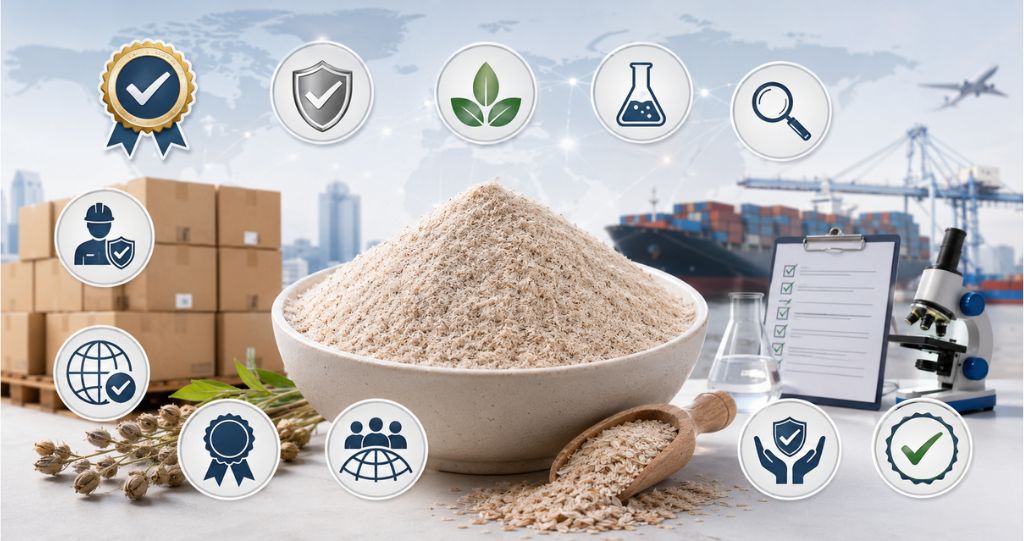
The top 10 certifications for psyllium husk powder export are FSSAI, ISO 22000, HACCP, GMP, USDA Organic and EU Organic, Halal, Kosher, BRCGS, US FDA facility registration, and APEDA or Spice Board registration. These credentials prove food safety, process control, and market specific compliance to importers across the USA, Europe, and the Middle East, and buyers audit them before the first sample ships. Because psyllium enters pharmaceuticals, supplements, and gluten free foods, certification effectively functions as the passport of the isabgol trade. Giriraj Enterprise maintains a complete certification stack so buyers of psyllium husk powder clear customs, pass retail audits, and satisfy regulators without friction.
Introduction
Certification is the entry ticket to the international psyllium trade, and no serious buyer contracts an unproven supplier regardless of how attractive the price appears. Because psyllium husk powder enters pharmaceuticals, dietary supplements, and gluten free foods consumed by health focused and often vulnerable populations, importers scrutinize supplier credentials rigorously, frequently auditing certification documentation before requesting even a trial sample. Each certification signals something specific: food safety system maturity, organic authenticity, religious compliance, retail audit readiness, or legal market access, and different destination markets weight them differently. A supplier targeting American supplement brands needs a different certification profile than one serving Middle Eastern isabgol buyers or European retail chains, though the strongest exporters hold the full stack to serve every market. For buyers, understanding what each certification proves prevents both under specifying, which risks quality problems, and over specifying, which needlessly narrows the supplier pool. For exporters, building and maintaining these credentials is the price of accessing premium global markets. Here are the ten certifications that matter most and what each one tells a buyer.
FSSAI License: The Baseline for Indian Psyllium Husk Powder Manufacturers
The Food Safety and Standards Authority of India license is the mandatory legal foundation for every food business operating in India, and it forms the baseline credential buyers should verify first in any psyllium husk powder manufacturer. The license confirms the operation meets India’s domestic food safety regulations covering hygiene, processing standards, and traceability, and it is prerequisite to obtaining the export authorizations that follow. Buyers should specifically confirm that the FSSAI registration covers manufacturing rather than merely trading, since a trading only license indicates the entity does not control processing and may simply be reselling material sourced from others, obscuring quality accountability. A manufacturing FSSAI license means the supplier operates its own processing facility, giving buyers a direct line of quality responsibility and audit access. The license also carries a verifiable registration number that buyers can check, adding a layer of due diligence. While FSSAI alone does not satisfy demanding export markets, its absence or a trading only designation is a warning sign. As the entry level credential, it anchors the certification profile that stronger export certifications build upon.
Get Bulk Psyllium, Spices & Grains QUOTES TODAY!



ISO 22000: Food Safety Management for Isabgol Export
ISO 22000 certifies a comprehensive food safety management system spanning the entire operation from raw isabgol procurement through processing to dispatch, demonstrating systematic hazard control rather than a single point inspection. The standard integrates HACCP principles with broader management system requirements, proving that the supplier has documented procedures, trained staff, monitoring systems, and corrective action processes covering every stage where food safety risk arises. For psyllium export, ISO 22000 signals to buyers that quality and safety result from a managed system rather than luck or individual diligence, giving confidence that performance will remain consistent across batches and over time. The certification requires external audits by accredited bodies and ongoing surveillance, so holding it proves sustained rather than momentary compliance. Buyers evaluating suppliers for long term relationships value ISO 22000 because it predicts reliability, the attribute that matters most once a product depends on a stable supply chain. Many international buyers list ISO 22000 or equivalent as a minimum requirement in their supplier qualification frameworks. It represents the transition from basic compliance to genuine food safety management.
HACCP: Hazard Analysis for Safe Psyllium Processing
HACCP certification documents a Hazard Analysis and Critical Control Points system that maps the specific points in psyllium processing where physical, chemical, or biological hazards must be controlled, and it underpins credible food safety in the sector. For psyllium, critical control points typically include destoning to remove heavy contamination, sieving and separation to achieve purity, metal detection to prevent physical hazards, and moisture control to suppress microbial growth, each monitored against defined limits with documented corrective actions.
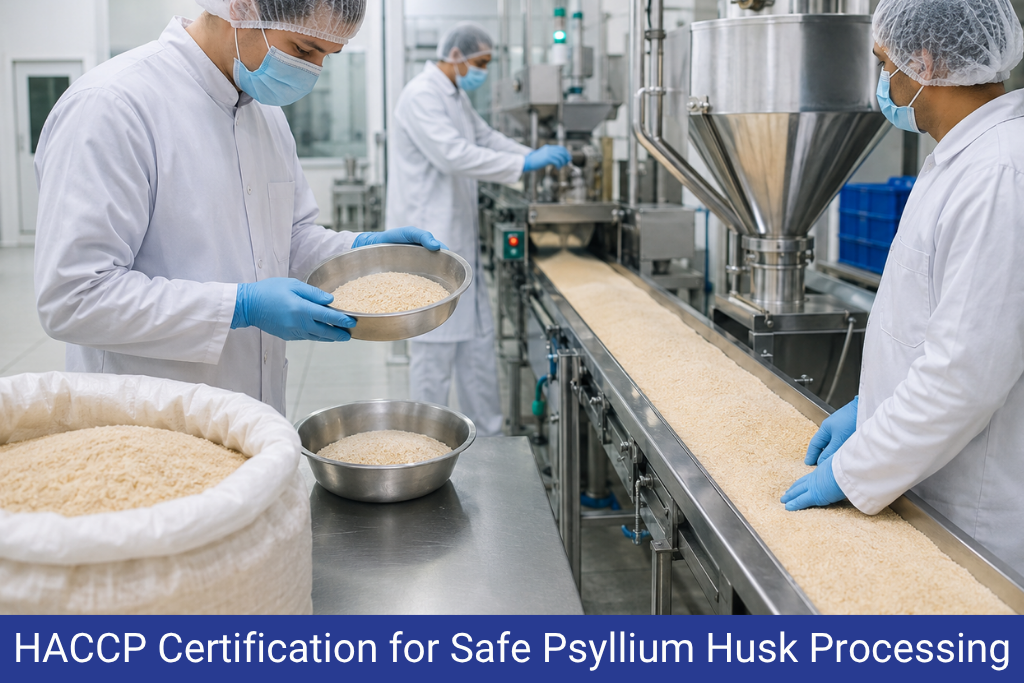
HACCP gives buyers documented assurance that hazards are identified and systematically controlled rather than left to chance, providing the analytical backbone that broader systems like ISO 22000 and retail standards like BRCGS build upon. The methodology is internationally recognized and forms the basis of food safety regulation in most developed markets, making HACCP compliance effectively universal for serious food export. Buyers frequently review a supplier’s HACCP plan during qualification to understand exactly how risks are managed at each processing stage. Suppliers who implement genuine HACCP, rather than merely holding a certificate, deliver the consistent safety that demanding pharmaceutical and food buyers require. It translates food safety principles into concrete operational controls.
Read Our Article
How to Identify High-Quality Psyllium Husk for Commercial Use?GMP: Good Manufacturing Practices for Pharma Grade Psyllium
Good Manufacturing Practices certification covers facility hygiene, equipment validation, personnel practices, and batch documentation, and it is the essential credential for pharma grade psyllium serving pharmaceutical and nutraceutical buyers. Because psyllium is a major pharmaceutical ingredient in bulk laxatives and fiber therapeutics, buyers in this channel require GMP compliance before qualifying any supplier, since their own drug and supplement manufacturing operates under GMP and demands the same standard from ingredient sources. GMP mandates documented procedures, controlled processing environments, equipment cleaning and validation, staff training and hygiene, and complete batch records that support the traceability pharmaceutical regulation requires. The certification proves that material is produced under conditions suitable for medicinal and health product use, a substantially higher bar than general food processing. Pharmaceutical buyers audit GMP compliance directly, often visiting facilities and reviewing batch records before contracting, and requalification costs make them loyal once satisfied. Suppliers holding GMP access the premium pharmaceutical and nutraceutical segment that pays the strongest prices for psyllium. For buyers, GMP is the dividing line between suppliers who can serve pharmaceutical applications and those limited to general food use. It signals manufacturing discipline at the highest practical level.
USDA Organic and EU Organic: Credentials for Organic Psyllium Husk Powder
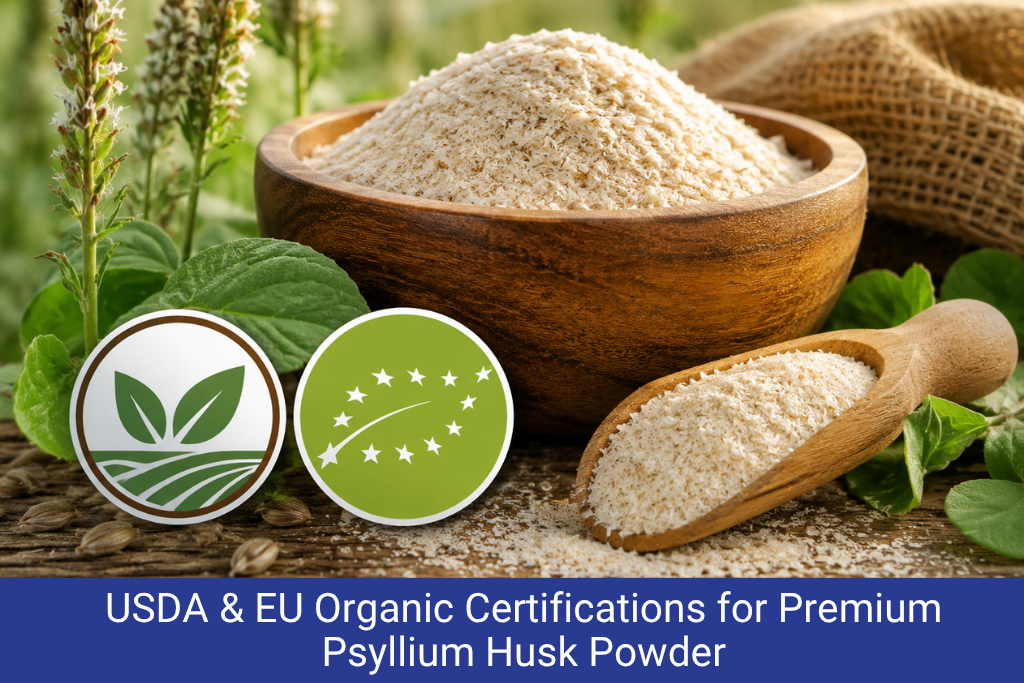
USDA NOP certification for the American market and EU 2018/848 compliance for Europe authenticate organic psyllium husk powder claims, and in India these connect to NPOP certified farm groups growing psyllium organically in Gujarat and Rajasthan. Organic psyllium commands significant retail premiums because health conscious consumers who buy fiber supplements and gluten free products align strongly with organic values, making certified organic material a large and growing segment of the export market.
Genuine organic certification requires an unbroken chain of custody: inspected organic farms using no prohibited inputs, segregated processing that prevents commingling with conventional material, and documented traceability from field to finished bag, all verified by accredited certification bodies through annual audits. Buyers demand the specific certification matching their destination, NOP for the USA and EU organic for Europe, and increasingly require both from suppliers serving multiple markets. The certification chain’s complexity means only committed organic suppliers maintain it properly, distinguishing them from traders making unverifiable organic claims. Suppliers holding dual USDA and EU organic certification serve the full organic market spectrum across the two largest consuming regions. For buyers, verified organic certification is the only credible basis for organic marketing claims on finished products.
Our Other Product
Amla Powder Without SeedsHalal Certification: Access to Middle East Isabgol Markets
Halal certification from recognized certifying bodies opens the substantial and growing isabgol markets of the UAE, Saudi Arabia, Indonesia, Malaysia, and the wider Muslim world, where importers and regulators expect it as standard. Psyllium enjoys strong demand across these markets both as a traditional digestive remedy deeply embedded in the culture and as a modern fiber supplement, and the large Muslim populations make Halal compliance a practical necessity rather than a niche consideration. Halal certification confirms that processing involves no prohibited substances and follows requirements acceptable to Muslim consumers, and while psyllium is inherently plant based, buyers still require formal certification for regulatory clearance and consumer confidence. Different markets recognize different Halal certifying bodies, so suppliers must hold certification from authorities accepted in their target destinations, a detail experienced exporters manage carefully. Indonesia in particular has moved toward mandatory Halal certification for imported consumer products, raising the stakes for suppliers serving that large market. Suppliers with recognized Halal certification and experience preparing appropriate documentation and labeling capture the Middle Eastern and Southeast Asian isabgol trade. For buyers in these regions, Halal certification is a baseline requirement for market entry.
Kosher Certification: Requirement for US Supplement Brands
Kosher certification, though associated with Jewish dietary law, functions in the American supplement and food industry as a broad quality and purity signal that many brands require regardless of their consumers’ religious affiliation. A significant share of US supplement and food companies specify Kosher certified ingredients across their formulations because major retailers and health brands have adopted it as a standard, making it a competitive edge for psyllium husk powder exporters targeting American private label programs.
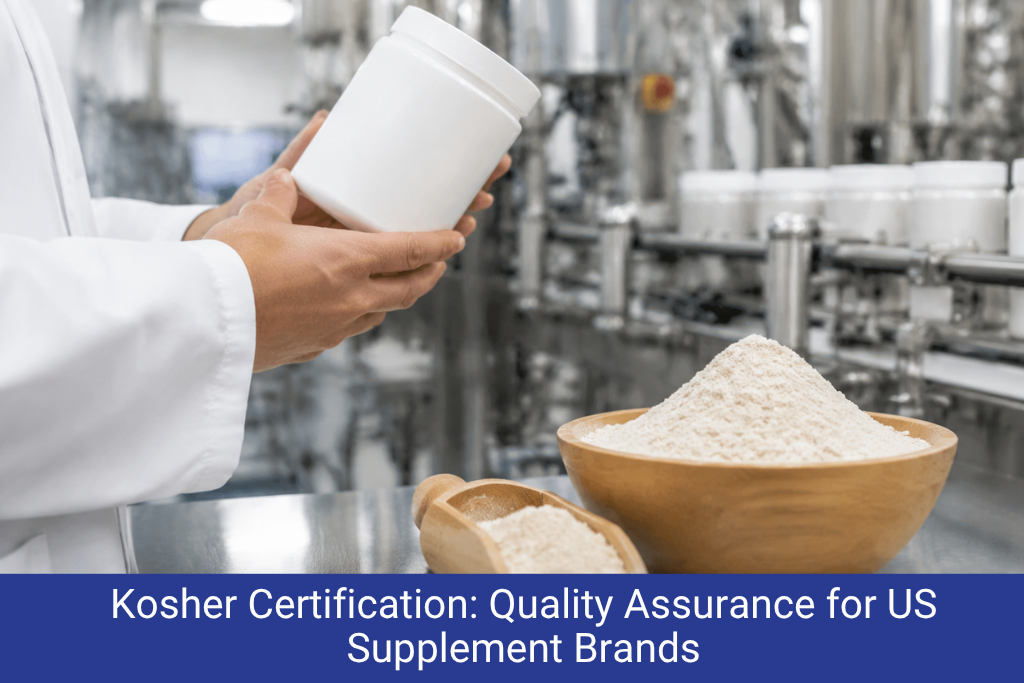
Kosher certification involves rabbinical inspection of ingredients, equipment, and processes, and for plant based psyllium the requirements are generally straightforward, but the formal certificate is what buyers need for their own product certifications. Because American private label and contract manufacturing represents a large psyllium market, holding Kosher certification meaningfully expands the addressable customer base for an exporter. Buyers building Kosher certified finished products require Kosher certified ingredients throughout their supply chain, so an uncertified psyllium supplier simply cannot participate. Suppliers who maintain Kosher certification alongside their other credentials position themselves for the American supplement industry’s substantial demand. For US focused exporters, Kosher certification is a practical commercial asset well beyond its religious origins.
BRCGS: Global Retail Standard for Private Label Psyllium Husk
BRCGS Food Safety certification represents the most rigorous retail audit standard in the food industry, and supermarket chains and large brands frequently mandate it before approving private label psyllium husk supply. The standard, developed by the British Retail Consortium and adopted globally, subjects suppliers to intensive announced and unannounced audits covering food safety systems, facility standards, product control, process control, and personnel practices, grading them on a scale that buyers use to filter their approved supplier lists. For psyllium suppliers, BRCGS certification unlocks the retail private label market where large volumes flow under supermarket and brand names, a segment inaccessible to suppliers who cannot pass its demanding requirements. Achieving and maintaining BRCGS certification requires substantial investment in systems, infrastructure, and continuous improvement, which is precisely why buyers trust it as a quality filter. The certification’s rigor means that a BRCGS certified supplier has effectively pre passed most other buyer audits, streamlining qualification. Buyers pursuing retail distribution of psyllium products increasingly treat BRCGS as non negotiable. Suppliers holding it access the highest volume, most stable retail supply relationships, making the certification investment commercially worthwhile.
US FDA Facility Registration: Legal Entry for Psyllium into America
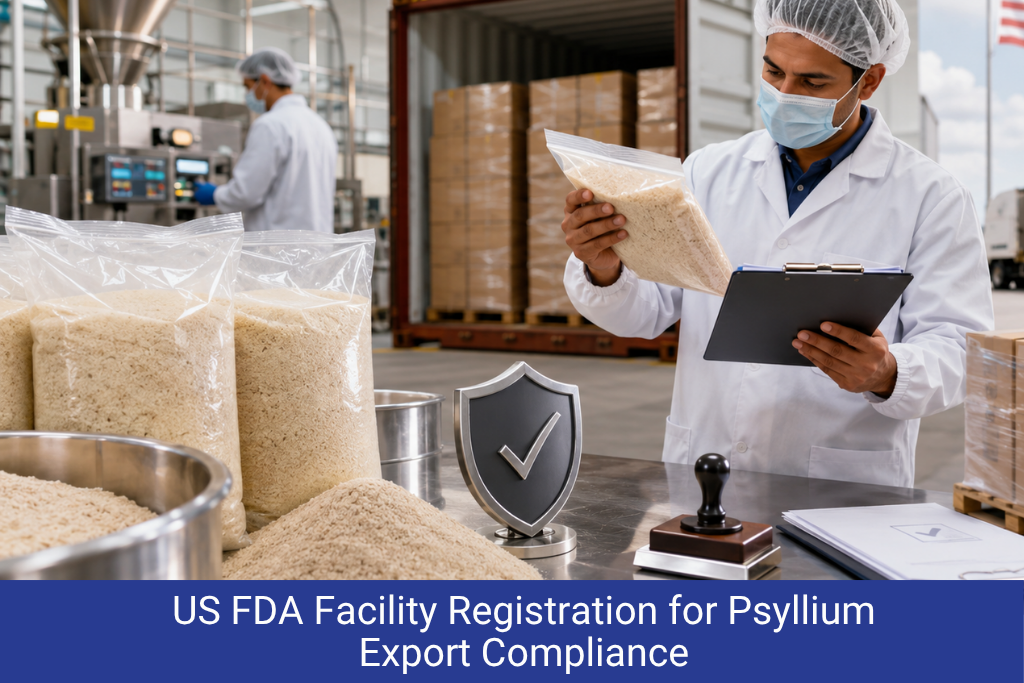
US FDA facility registration is the legal prerequisite for any facility exporting food to the United States, without which shipments cannot legally enter, making it fundamental rather than optional for psyllium husk powder exporters serving the large American market. Registration requires the facility to file with the FDA, maintain a US agent, and comply with Food Safety Modernization Act requirements, while each shipment additionally requires prior notice filing before arrival so the FDA can screen incoming food.
Failure to register or file prior notice results in shipments being refused entry at American ports, stranding cargo and destroying the transaction, so this compliance is absolutely load bearing for US trade. Because the United States is among the largest psyllium markets, driven by its enormous supplement industry and fiber conscious consumers, FDA compliance effectively gates access to a major share of global demand. Buyers importing to the US require their suppliers to be FDA registered and capable of correct prior notice filing, treating these as baseline qualifications. Suppliers experienced in US documentation, including FDA registration, prior notice, and FSMA compliance, remove friction from American trade. For any exporter serious about the US market, FDA facility registration is simply the entry requirement.
Our Other Product
Psyllium Husk PowderAPEDA and Spice Board Registration: Indian Export Authorization
APEDA registration authorizes agricultural product export from India and, together with Spice Board registration for spices, completes the compliance chain that legally enables and supports psyllium export from the country. The Agricultural and Processed Food Products Export Development Authority registration is required for exporting products in its scope and additionally enables access to export promotion schemes and incentives that improve exporter competitiveness. Spice Board registration applies to spice exports and connects suppliers to that body’s quality guidance and market development support. These Indian side authorizations, while less visible to foreign buyers than international certifications, are essential because they permit the export transaction to occur legally and often unlock financial and promotional support that strengthens the supplier’s overall offering. Buyers benefit indirectly because these registrations indicate an established, properly constituted exporter operating within India’s regulatory framework rather than an informal trader. Suppliers holding complete Indian export authorizations alongside international certifications present a fully compliant profile from origin to destination. For buyers, confirming these registrations provides additional assurance of supplier legitimacy. Together with the international certifications above, they complete the credential set that defines a truly export ready psyllium supplier.
Export Ready Psyllium, Spices & Grains Await! CALL US

Why Buyers Choose Giriraj Enterprise as a Certified Psyllium Husk Supplier
- A complete certification stack maintained and renewed annually spanning food safety, organic, religious, and market access credentials
- Documentation support for FDA prior notice filing, health certificates, phytosanitary requirements, and destination specific paperwork
- Segregated certified organic and conventional processing lines serving the full market spectrum
- Contract manufacturing and isabgol private label manufacturer services producing psyllium husk powder under buyer brand names
- An audit ready facility open to buyer inspections, video audits, and third party verification
- Experienced export handling that removes regulatory friction across American, European, and Middle Eastern markets
Frequently Asked Questions
Which certification is most important for exporting psyllium husk powder to the USA?
US FDA facility registration is legally mandatory for any food entering the United States, without which shipments are refused. GMP, Kosher, and USDA Organic then strengthen commercial acceptance with American supplement and food buyers.
Is Halal certification necessary for psyllium export?
It is essential for Middle Eastern and Southeast Asian markets, including the UAE, Saudi Arabia, Indonesia, and Malaysia, where importers and regulators expect Halal certification and, increasingly, mandate it for imported consumer products.
What does BRCGS certification mean for a psyllium buyer?
BRCGS indicates the supplier passes the most rigorous retail food safety audits, qualifying them for supermarket and brand private label supply. A BRCGS certified supplier has effectively pre passed most other buyer qualification requirements.
Does organic psyllium husk powder need separate certification?
Yes. Organic claims require USDA NOP for America or EU organic for Europe, backed in India by NPOP certification, with an unbroken traceable chain from inspected organic farms through segregated processing to the finished bag.
Does Giriraj Enterprise offer private label psyllium husk manufacturing?
Yes. Giriraj Enterprise operates as an isabgol private label manufacturer, producing custom branded psyllium husk powder with complete certification documentation and export paperwork issued under the buyer’s own brand.

Mihir Shah is the CEO of Giriraj Enterprise, a trusted manufacturer, supplier, and exporter of Psyllium products, whole spices, ground spices, herbal products, guar gum and other agro products like Quinoa Seeds, Chia Seeds including Isabgol, Plantago ovata Seeds, Ispaghula Husk Powder and Kha Kha Powder. Founded in 1973 and based in Unjha, Gujarat, Giriraj Enterprise has grown significantly under Mihir’s leadership, establishing itself as a trusted name in the global market. With a focus on high-quality standards and adherence to international food norms, the company serves a wide customer base across the globe.
A strategic thinker with a passion for sustainable growth, Mihir has played a pivotal role in expanding the company’s production capacity, which now stands at 3,000 quintals per month, and in ensuring that Giriraj Enterprise remains at the forefront of innovation in the industry. His commitment to quality is reflected in the company’s stringent in-house quality testing and third-party verification, ensuring that all products meet the highest standards of excellence. He is dedicated to driving customer satisfaction by offering fast, reliable services both domestically and internationally.
Through his writing, Mihir shares valuable insights and knowledge about Psyllium, spices, herbal and other agro products, educating readers on their benefits and the role they play in promoting health and well-being. His goal is to provide factual, transparent information to help consumers and businesses make informed decisions.