



AI Summary
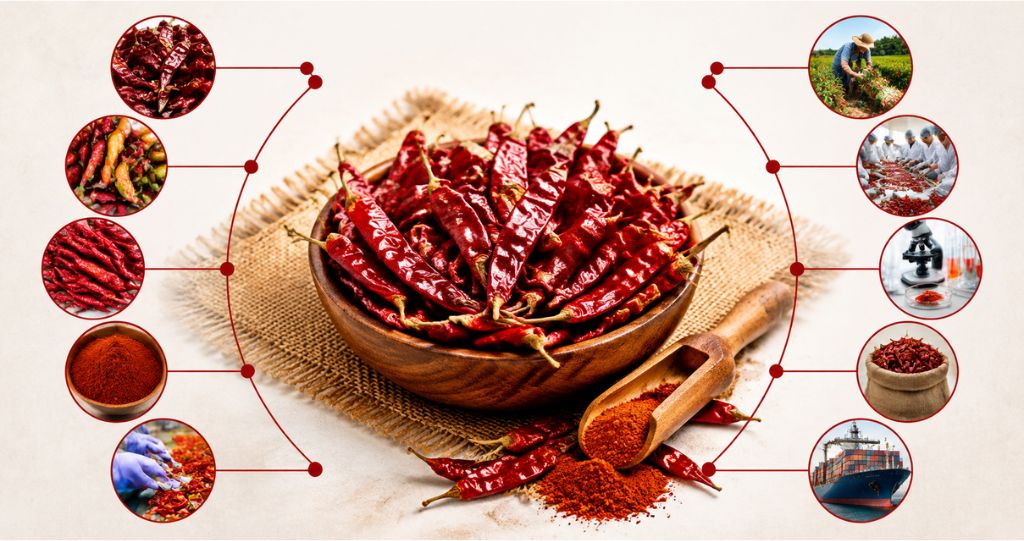
The top 10 factors determining red chilli export quality are ASTA color value, Scoville heat units, aflatoxin levels, pesticide residues, moisture content, pod integrity and appearance, foreign matter percentage, microbial load, sudan dye absence, and export packaging with fumigation standards. International buyers and food safety authorities reject shipments failing any single parameter, and the EU Rapid Alert System flags Indian chilli consignments regularly, making compliance a commercial survival issue rather than a formality. Working with quality focused red chillies exporters like Giriraj Enterprise, who test every batch against destination specific norms, protects importers from costly port rejections, re export expenses, and regulatory blacklisting.
Introduction
Red chilli is among the most heavily scrutinized commodities in international food trade because it combines several distinct risk profiles in a single product, natural toxin exposure through aflatoxin, high pesticide use in cultivation, historical adulteration with illegal dyes, and microbial contamination from open air drying. The EU Rapid Alert System for Food and Feed publishes chilli rejections routinely, the US FDA maintains import alerts, and China, Japan, and Gulf authorities each enforce their own tolerance frameworks. A rejected container costs the importer the cargo value, return freight, destruction fees, and often future business, so professional buyers write detailed specifications and audit their red chilli suppliers India offers against them. For exporters, mastering these ten parameters is the difference between building durable customer relationships and lurching from one rejection crisis to the next. Understanding each factor also lets importers write correct purchase contracts and evaluate supplier claims intelligently. Here is what actually determines whether a chilli shipment clears or fails.



ASTA Color Value: The Redness Benchmark for Dry Red Chilli Specifications
ASTA color value measures the extractable red pigment in red chilli using a standardized spectrophotometric method, and it forms the primary quality axis in nearly every purchase contract. Table and culinary grades typically range from 60 to 100 ASTA, while color extraction varieties like Byadgi exceed 150, and buyers specify a minimum ASTA figure that shipments must meet or beat. Color develops through proper ripening on the plant and is preserved or destroyed by drying method; slow shade adjacent drying protects pigment while excessive sun exposure and heat degrade it, so processing discipline directly determines the achievable value. Storage matters too, since color fades gradually over months, meaning old stock sold as fresh fails specifications that new crop material would pass. Extraction buyers pay premiums per color unit above their minimum, turning ASTA into a direct pricing lever. Suppliers who measure color on every lot and store material in temperature controlled conditions consistently deliver the values contracts demand, while careless shippers face rejection when laboratory testing at destination reveals faded pigment.
Scoville Heat Units: Measuring Capsaicin Pungency in Export Chilli
Scoville Heat Units quantify the pungency delivered by capsaicin and related capsaicinoids, and this figure defines fitness for purpose across completely different buyer segments. Extraction and hot sauce buyers demand maximum heat, contracting for Teja grade material above 70,000 SHU, while culinary color buyers want the opposite, specifying mild Kashmiri type chilli below 2,000 SHU where any meaningful heat would ruin the application. Modern testing uses HPLC to measure capsaicinoid concentration precisely, replacing the old subjective taste panel, so buyers receive objective numbers they can contract against.
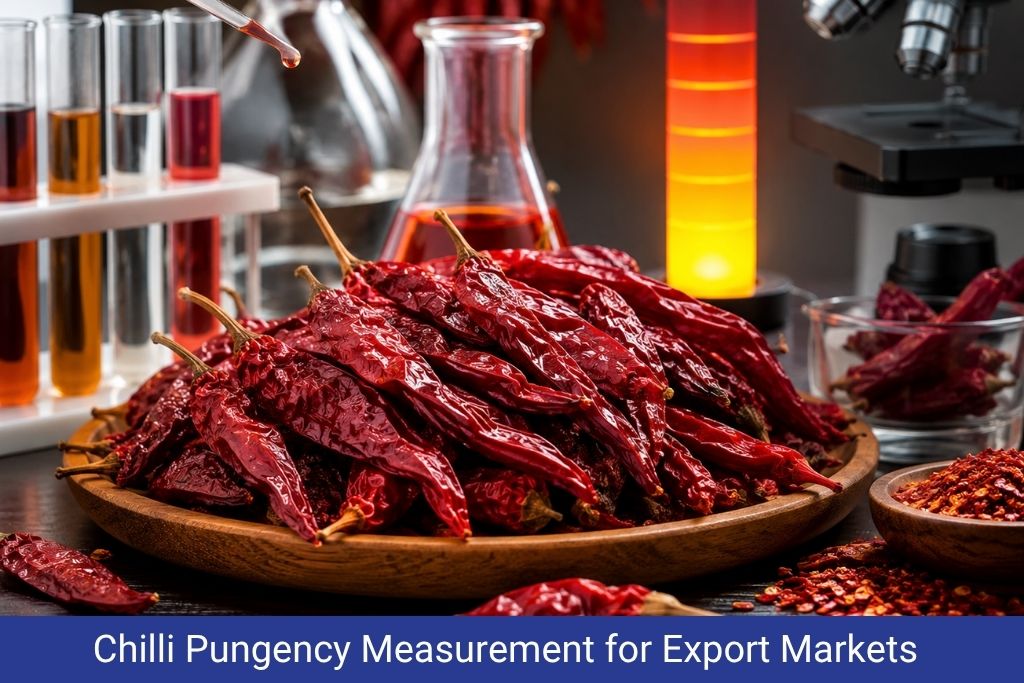
Heat varies by variety, growing conditions, and even position on the plant, meaning a supplier must understand and control raw material sourcing to deliver consistent pungency batch after batch. Blending different lots to hit a target SHU is common practice among skilled processors serving buyers who need a specific heat band. For importers, specifying SHU correctly prevents the expensive mismatch of receiving fiery chilli for a mild application or weak chilli for an extraction contract that pays on capsaicin yield.
Read Our Article
Pricing Trends and Factors Affecting Whole Spice CostsAflatoxin Levels: The Most Critical Food Safety Parameter in Chilli
Aflatoxin is the single most dangerous and rejection prone parameter in chilli export, produced by Aspergillus molds that colonize pods when drying is slow, moisture lingers, or storage humidity rises. The EU enforces a strict limit of 5 parts per billion for aflatoxin B1 and 10 parts per billion total, among the tightest in the world, while other markets set their own thresholds, and testing at destination is routine for chilli. Prevention is the only reliable strategy because contamination cannot be reversed once present; it depends on harvesting at correct ripeness, rapid drying on clean tarpaulins rather than bare ground, achieving safe moisture quickly, and maintaining dry storage thereafter. Contaminated lots must be identified and diverted before shipment through representative sampling and laboratory testing, since aflatoxin distributes unevenly and a single hot spot fails an entire container. Suppliers who control the drying and storage chain, test rigorously, and reject marginal material protect their buyers from the recalls and blacklisting that aflatoxin failures trigger. This parameter alone justifies working only with disciplined, well equipped red chillies exporters.
Pesticide Residue Compliance: Meeting MRL Norms of Importing Countries
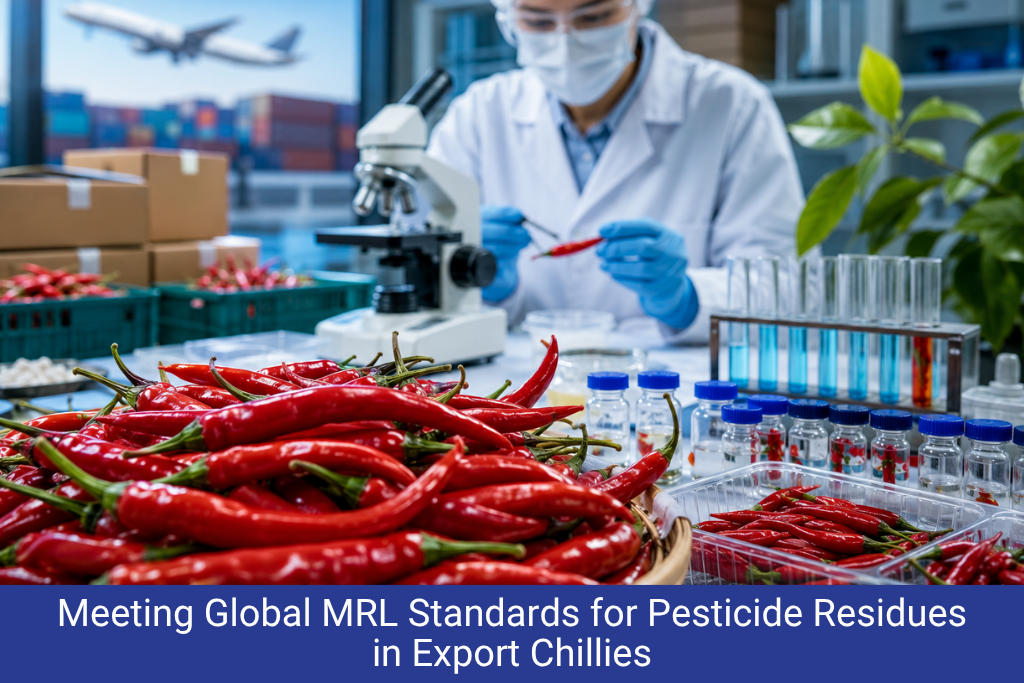
Every destination enforces its own Maximum Residue Limits for agricultural chemicals, and chilli, an intensively sprayed crop, frequently exceeds them when farm level pesticide use goes uncontrolled. Compounds like ethion, triazophos, profenofos, and acephate appear repeatedly in rejection notices, and because MRLs differ between the EU, USA, Japan, and Gulf states, a lot compliant for one market may fail another, complicating supplier logistics.
Meaningful compliance begins in the field, requiring suppliers to work with monitored farmer groups, advise on approved chemicals and pre harvest intervals, and screen raw material before purchase rather than discovering violations after processing. Multi residue laboratory testing covering hundreds of compounds has become standard for developed market shipments, adding cost that legitimate exporters absorb as the price of market access. Buyers increasingly demand residue certificates specific to their destination’s MRL framework, refusing generic reports. Suppliers who invest in farm partnerships and analytical testing convert this regulatory burden into a competitive moat, since casual traders cannot reliably meet the standard and steadily lose access to premium markets.
Our Other Product
Sesame SeedsMoisture Content: The Foundation of Safe Chilli Storage and Transit
Moisture content sits at the center of chilli quality because it governs both aflatoxin risk and physical condition, and export material must hold between 8 and 11 percent. Above this range, residual moisture invites mold growth and aflatoxin development during the weeks a container spends crossing oceans through varying temperature and humidity, turning a passing lot at loading into a failed one at arrival. Below the range, pods become brittle and shatter during handling, generating dust and broken fragments that reduce grade and usable weight. Achieving the target requires proper drying to a controlled endpoint rather than rushed or incomplete drying, and maintaining it demands moisture barrier packaging and dry storage. Suppliers measure moisture at multiple stages, at intake, after any conditioning, and before packing, treating it as a control point rather than an afterthought. Buyers should specify moisture in contracts and understand that a supplier’s moisture discipline signals overall processing competence. Consistent moisture management is quietly one of the strongest predictors of whether a shipment will clear destination inspection intact.
Pod Integrity and Appearance: Visual Grading of Whole Red Chillies
For whole chilli shipments, visual quality drives grade and price, and buyers assess pods on length uniformity, deep even red color, glossy unblemished skin, and freedom from white patches, black spots, or discoloration. Premium markets supplying retail whole chilli or high end grinding pay substantial premiums for unbroken, uniformly colored pods, while broken, spotted, or faded material sells into lower value channels. Appearance reflects the entire production chain: healthy plants, correct harvest timing, careful drying that avoids scorching or mold spotting, and gentle handling that limits breakage all show in the finished pod.
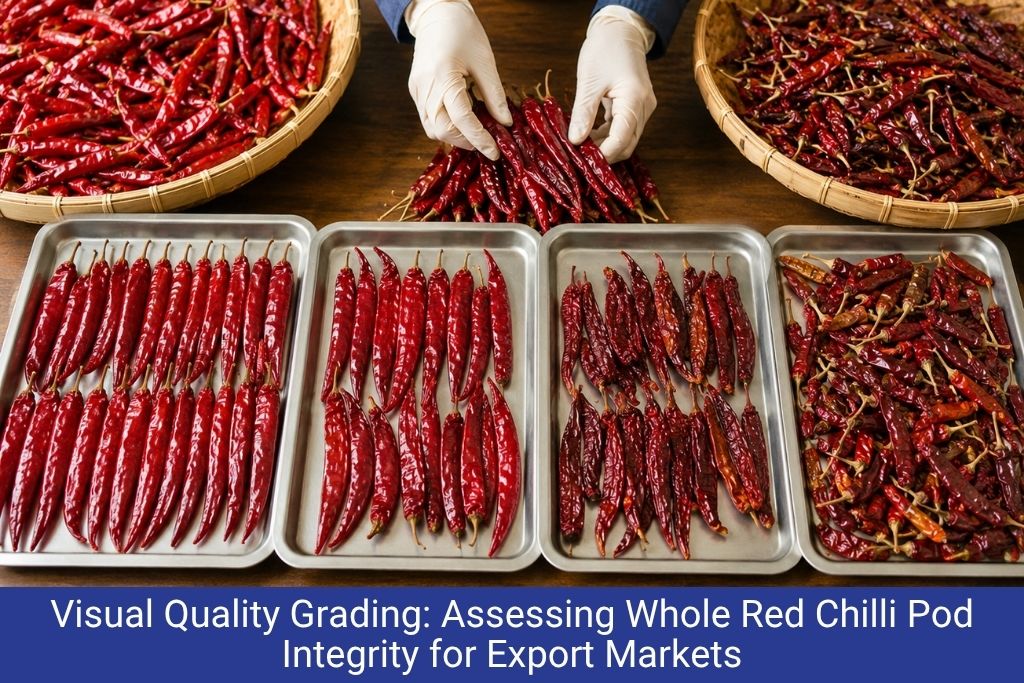
Sorting removes defective pods, and color sorting technology separates faded or discolored material from premium grade, letting processors present consistent visual quality. Whole chilli buyers often inspect pre shipment samples and reserve the right to reject on appearance even when analytical parameters pass, making visual grade a genuine commercial gatekeeper. Suppliers who invest in sorting and handle pods carefully command the premiums that appearance sensitive buyers willingly pay, while careless handling destroys value that field quality had created.
Our Other Product
Coriander PowderForeign Matter Percentage: Cleanliness Standards in Spice Export
Foreign matter, meaning stones, soil, stalks, dust, loose seeds, and extraneous plant material, must stay below one percent for export grade chilli, and developed market buyers often demand tighter tolerances still. Open air drying on ground surfaces introduces contamination that only mechanical cleaning removes, so processing infrastructure directly determines achievable cleanliness. Destoning separates stones and heavy debris by density, air classification removes light chaff and dust, and sortex color sorting eliminates discolored fragments and remaining foreign particles, together bringing material within specification. Metal detection guards against the metal fragments that damage grinding equipment and trigger recalls, an increasingly standard requirement in supply contracts. Buyers care about foreign matter both for product quality and because stones and debris represent paid weight delivering no value, effectively inflating the real per kilogram cost of usable chilli. Suppliers with complete cleaning lines present visibly cleaner material that passes inspection confidently, while those relying on manual sorting alone struggle to meet modern cleanliness thresholds. Cleanliness, like moisture control, signals overall processing capability to discerning buyers.
Microbial Load: Salmonella and Total Plate Count Limits
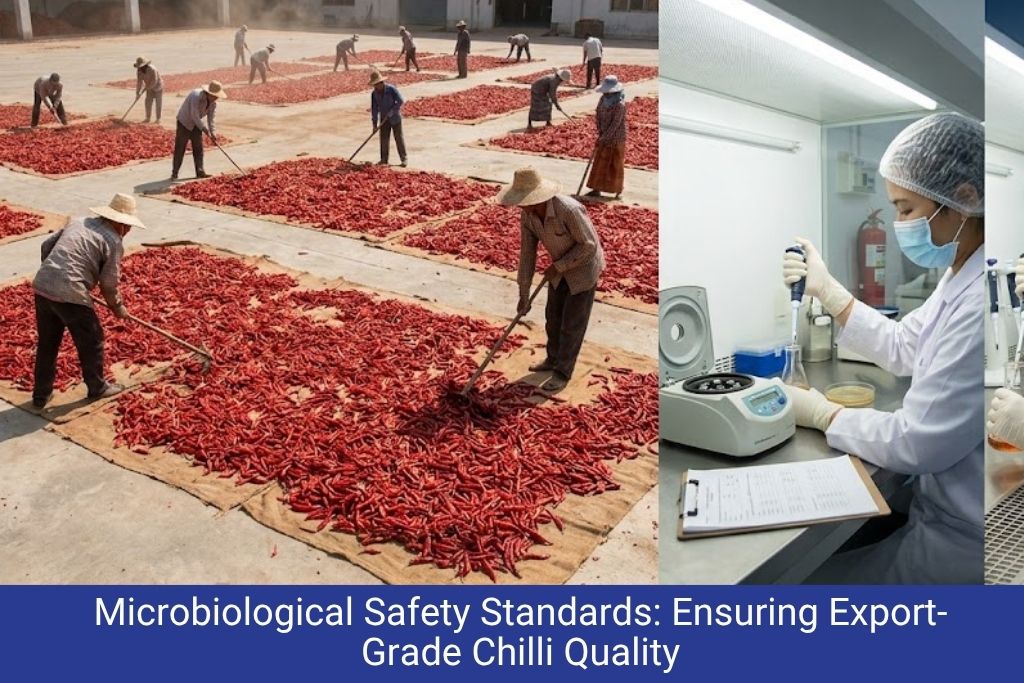
Developed market buyers enforce strict microbiological standards, demanding absence of Salmonella in 25 gram samples, controlled total plate counts, and limits on yeast, mold, and coliforms, reflecting chilli’s contamination exposure during open air drying and handling. Raw chilli routinely carries microbial loads that exceed the specifications of European, American, and Japanese food manufacturers, so microbial reduction treatment becomes necessary for these markets.
Steam sterilization is the preferred method because it reduces pathogens and total counts while preserving color, flavor, and, where required, organic and clean label status, unlike chemical fumigation methods restricted in many markets. Suppliers offering validated steam treatment access premium buyers that raw material cannot serve, turning microbial capability into a market access advantage. Testing must confirm treatment effectiveness on each lot, since buyers require certificates proving their specifications are met. For importers, understanding whether a supplier can deliver microbially compliant chilli determines which finished product markets they can serve. Microbial control increasingly separates suppliers targeting sophisticated food manufacturers from those limited to less demanding regional trade.
Sudan Dye Absence: Guarding Against Adulteration in Chilli Powder
Sudan dyes, illegal industrial red colorants historically added to chilli powder to fake or boost redness, remain a serious food safety concern because they are carcinogenic and periodically resurface in global supply chains. The EU and other authorities test specifically for Sudan I through IV, and any detection triggers immediate rejection, product recall, and reputational damage that can end a supplier’s market access permanently. Reputable chilli powder manufacturers guard against this risk through controlled sourcing that avoids questionable material and chromatographic testing of finished powder to certify dye absence before shipment. The risk concentrates in powder rather than whole pods, since adulteration requires the mixing that grinding provides, making powder buyers especially vigilant and powder suppliers especially accountable. Buyers increasingly demand Sudan free certificates as standard documentation for every chilli powder consignment, treating their absence as grounds to refuse a supplier. For legitimate exporters, rigorous Sudan testing is both a safety obligation and a trust signal that distinguishes them from the opaque traders who allow such adulteration. Guaranteeing dye free powder is fundamental to serious chilli powder export.
Packaging and Fumigation: Protecting Quality Until Destination
The finest chilli fails commercially if packaging and fumigation do not preserve its quality and satisfy phytosanitary requirements through the long journey to destination. Export standard packaging uses food grade jute or woven polypropylene bags with inner liners that block moisture ingress, protecting the carefully controlled moisture content against humid transit conditions that would otherwise invite mold. Pallets meeting ISPM 15 heat treatment standards prevent pest transfer and satisfy import quarantine, while documented fumigation eliminates insects that could otherwise infest cargo and trigger rejection at biosecurity conscious destinations like Australia. Correct labeling, lot coding, and accompanying certificates complete the package that customs and food safety inspectors examine on arrival. Poor packaging undoes upstream quality work, allowing moisture damage, pest infestation, or contamination that transforms compliant material into rejected cargo. Suppliers who treat packaging and phytosanitary compliance as integral to quality, rather than a shipping afterthought, deliver chilli that arrives in the condition it left, which is ultimately all that matters to the buyer receiving it. This final parameter closes the chain from field to destination shelf.

How Giriraj Enterprise Guarantees Red Chilli Export Quality
- Sourcing from monitored farms across Guntur, Khammam, and Byadgi regions with guidance on approved chemicals and pre harvest intervals
- Complete processing line featuring sortex color sorting, destoning, air classification, and metal detection
- NABL accredited third party testing for aflatoxin, multi residue pesticides, Sudan dyes, and full microbiology on every lot
- Pre shipment sample approval with a destination specific Certificate of Analysis accompanying each container
- Validated steam sterilization for buyers requiring microbial reduction while preserving color and clean label status
- End to end traceability from farm lot through processing to shipped container, supporting audits and rapid issue resolution
Frequently Asked Questions
What is the acceptable aflatoxin limit for chilli exports to Europe?
The EU permits a maximum of 5 parts per billion aflatoxin B1 and 10 parts per billion total aflatoxins in chilli, among the strictest limits globally, and shipments are routinely tested at destination.
What moisture level is safe for dry red chilli export?
Between 8 and 11 percent moisture is the international standard. Higher moisture invites mold and aflatoxin during transit, while lower moisture makes pods brittle and prone to breakage and dust formation.
Why do chilli shipments get rejected at destination ports?
The most common reasons are aflatoxin exceedance, pesticide residue violations, Sudan dye detection, high microbial or Salmonella counts, excessive foreign matter, and packaging or phytosanitary documentation failures.
What ASTA value should buyers specify for chilli powder?
General culinary chilli powder typically requires 60 to 90 ASTA, while color focused applications such as Kashmiri style or extraction grade products need 120 ASTA or higher. Buyers should state a minimum in the contract.
How does Giriraj Enterprise ensure compliant red chilli quality?
Through monitored farm sourcing, a complete sortex and metal detection processing line, NABL accredited batch testing for all critical parameters, steam sterilization capability, and destination specific documentation on every shipment.

Mihir Shah is the CEO of Giriraj Enterprise, a trusted manufacturer, supplier, and exporter of Psyllium products, whole spices, ground spices, herbal products, guar gum and other agro products like Quinoa Seeds, Chia Seeds including Isabgol, Plantago ovata Seeds, Ispaghula Husk Powder and Kha Kha Powder. Founded in 1973 and based in Unjha, Gujarat, Giriraj Enterprise has grown significantly under Mihir’s leadership, establishing itself as a trusted name in the global market. With a focus on high-quality standards and adherence to international food norms, the company serves a wide customer base across the globe.
A strategic thinker with a passion for sustainable growth, Mihir has played a pivotal role in expanding the company’s production capacity, which now stands at 3,000 quintals per month, and in ensuring that Giriraj Enterprise remains at the forefront of innovation in the industry. His commitment to quality is reflected in the company’s stringent in-house quality testing and third-party verification, ensuring that all products meet the highest standards of excellence. He is dedicated to driving customer satisfaction by offering fast, reliable services both domestically and internationally.
Through his writing, Mihir shares valuable insights and knowledge about Psyllium, spices, herbal and other agro products, educating readers on their benefits and the role they play in promoting health and well-being. His goal is to provide factual, transparent information to help consumers and businesses make informed decisions.