



AI Summary
The top 10 quality parameters every psyllium husk buyer should check are purity percentage, swell volume, mesh size, moisture content, light and heavy extraneous matter, microbial load, heavy metals, pesticide residues, color and appearance, and gluten or allergen status. Premium export grade psyllium husk from Plantago ovata offers 95 to 99 percent purity and swell volume above 40 milliliters per gram, the functional benchmark for pharmaceutical and supplement use. India supplies over 80 percent of the world’s psyllium, known locally as isabgol, from Gujarat and Rajasthan. Giriraj Enterprise, among established psyllium husk manufacturers in India, certifies every parameter on batch wise Certificates of Analysis for buyers worldwide.
Introduction
India dominates global psyllium like no other spice or seed, supplying over 80 percent of world demand from the arid farms of Gujarat and Rajasthan where the Plantago ovata plant thrives, and where the crop is known traditionally as isabgol. This near monopoly exists because psyllium requires precise dry growing conditions that the region provides ideally, and because generations of Indian farmers and processors have built the specialized knowledge that quality husk demands. Psyllium’s commercial importance rests on its extraordinary soluble fiber, which absorbs water and swells into a gel used across pharmaceuticals, laxative formulations, gluten free baking, and the fast growing dietary fiber supplement market. Because these applications range from over the counter medicines to functional foods, buyers must verify precise specifications before confirming any purchase, since a lot suitable for animal feed differs enormously from one meeting pharmaceutical monographs. Ten parameters separate premium export husk from commodity material, and understanding each lets buyers write correct contracts and evaluate suppliers accurately. Here is what every serious psyllium buyer should check.
Purity Percentage: The Core Grade of Export Psyllium Husk
Purity percentage defines what fraction of the material is true husk, the outer seed coat carrying the functional fiber, versus seed fragments, plant matter, and fines, and it forms the primary grade designation in psyllium trade. Commercial grades run at 85, 95, 98, and 99 percent purity, and this single number drives pricing more than any other, since higher purity requires more processing passes and yields less finished product per tonne of raw seed. Pharmaceutical and supplement buyers demand 98 percent and above because their formulations and regulatory filings depend on consistent, high functionality material, while lower grades serve industrial and less demanding food uses. Achieving high purity requires repeated milling and sieving that separates husk from seed by density and particle behavior, infrastructure that distinguishes serious manufacturers from basic processors. Buyers should specify exact purity in contracts and understand that claimed purity must be verifiable through laboratory analysis, since visual assessment alone cannot confirm it. Purity also correlates with swell volume and overall performance, making it the foundational quality decision from which most other parameters follow. Getting purity right anchors the entire specification.
Export Ready Psyllium, Spices & Grains Await! CALL US



Swell Volume: Measuring the Functional Power of Isabgol
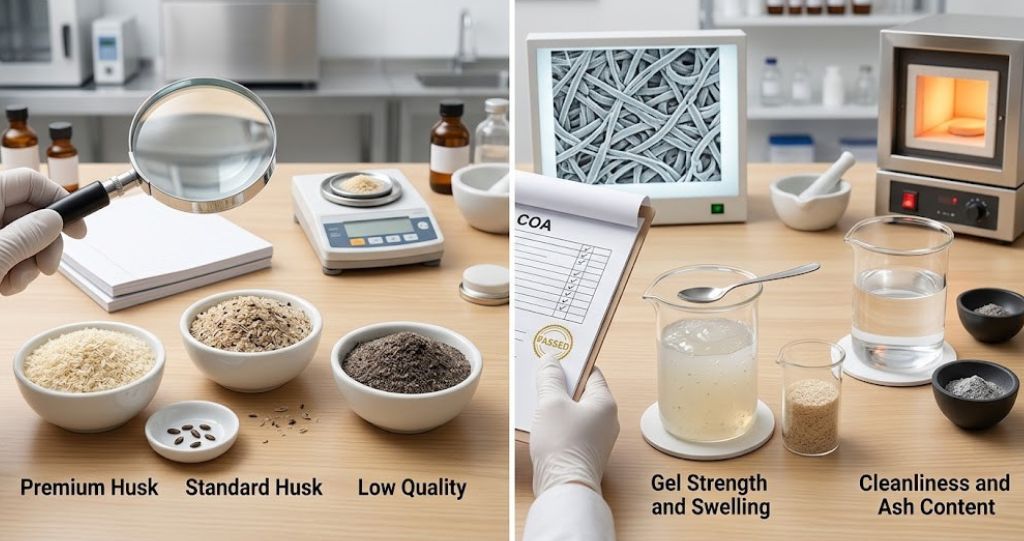
Swell volume measures how many milliliters one gram of husk expands to when hydrated, directly quantifying the functional performance that makes isabgol valuable, and quality material achieves 40 milliliters per gram or more. This single measurement determines laxative efficacy in pharmaceutical use, gel strength in gluten free baking where psyllium replaces gluten’s binding function, and mouthfeel in fiber beverages, making it the parameter most closely tied to actual product performance. Swell volume depends on purity and processing gentleness, since aggressive milling can damage the fiber structure that generates the gel, meaning a supplier can hold high purity yet deliver disappointing swell volume through careless handling. Pharmaceutical buyers formulating bulk laxatives specify minimum swell volume rigorously because under performing husk fails clinical expectations and regulatory standards. Bakers developing gluten free products test swell volume because it predicts how well psyllium will bind and structure their dough. Buyers should always request swell volume data rather than assuming purity alone guarantees performance, and suppliers who measure and report it demonstrate genuine quality understanding. This functional metric ultimately matters more to end use than any cosmetic parameter.
Mesh Size: Choosing Between Whole Husk and Psyllium Husk Powder
Mesh size determines the physical form and therefore the application suitability of psyllium, spanning whole husk flakes through finely milled psyllium husk powder in 40, 60, 80, and 100 mesh grades. Whole husk suits supplement flakes and traditional consumption where consumers stir it into water, while powder serves gluten free baking, capsule filling, beverages, and pharmaceutical formulations requiring fine, uniform particles that disperse and hydrate predictably. Finer mesh disperses faster and integrates more smoothly into formulations, but it also clumps more readily and requires careful handling and often agglomeration control to remain usable.
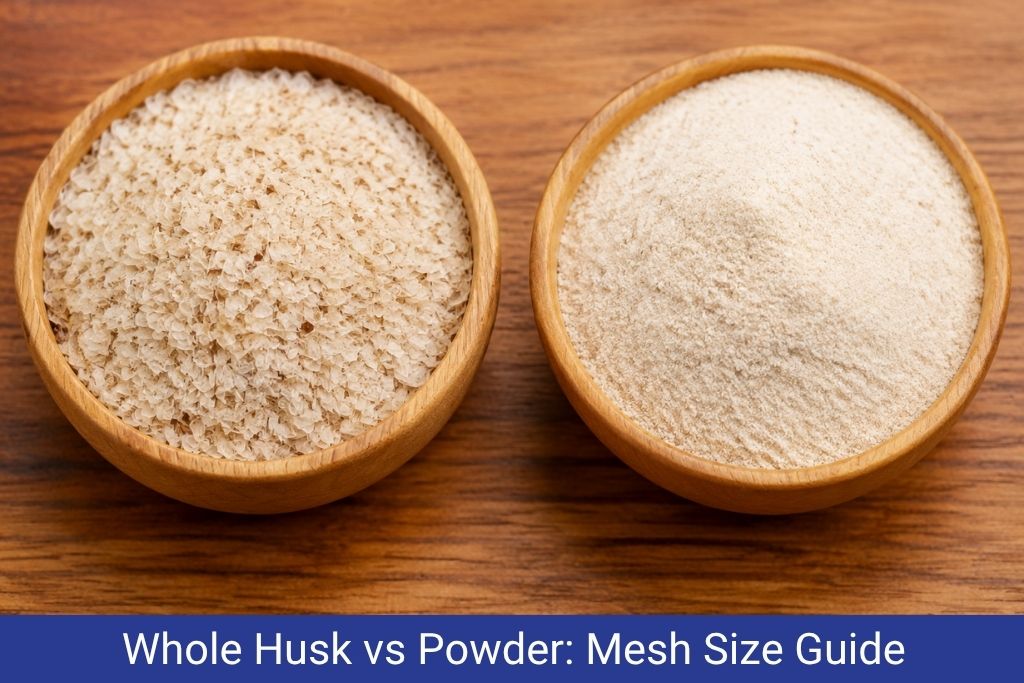
The choice between forms and mesh grades is application driven, and buyers must match their specification to their manufacturing process, since baking, capsule filling, and beverage production each favor different particle sizes. Suppliers capable of milling to multiple mesh specifications from a single quality husk base serve diverse buyers without compromising the underlying purity and swell volume. Buyers should specify mesh precisely and confirm the supplier can hold it consistently, since particle size variation disrupts automated manufacturing. Mesh selection connects the raw material quality to the practical realities of the buyer’s production line.
Read Our Article
Psyllium Husk Powder: Industrial & Commercial ApplicationsMoisture Content: Protecting Bulk Psyllium Husk Powder in Transit
Moisture content must stay below 12 percent, ideally near 10 percent, to protect bulk psyllium husk powder against microbial growth and caking during the humid ocean voyages that international shipments endure. Psyllium’s hygroscopic nature means it readily absorbs atmospheric moisture, so both the drying endpoint at processing and the barrier quality of packaging determine whether material arrives in usable condition. Excess moisture invites mold and bacterial proliferation that fails microbiological specifications and can render an entire container unsellable, while it also promotes caking that turns free flowing powder into solid masses requiring rework. Suppliers control moisture through proper drying and by packing in moisture barrier liners within their export bags, treating it as a preservation critical parameter rather than a formality. Buyers importing to humid climates should pay particular attention to moisture specification and packaging integrity, since transit through tropical conditions stresses the material most. Moisture also affects weight, so buyers pay for water rather than fiber when it runs high, giving a commercial as well as quality reason to specify tightly. Consistent moisture control signals a supplier’s overall processing and packaging discipline.
Light and Heavy Extraneous Matter: Cleanliness of Plantago Ovata Husk
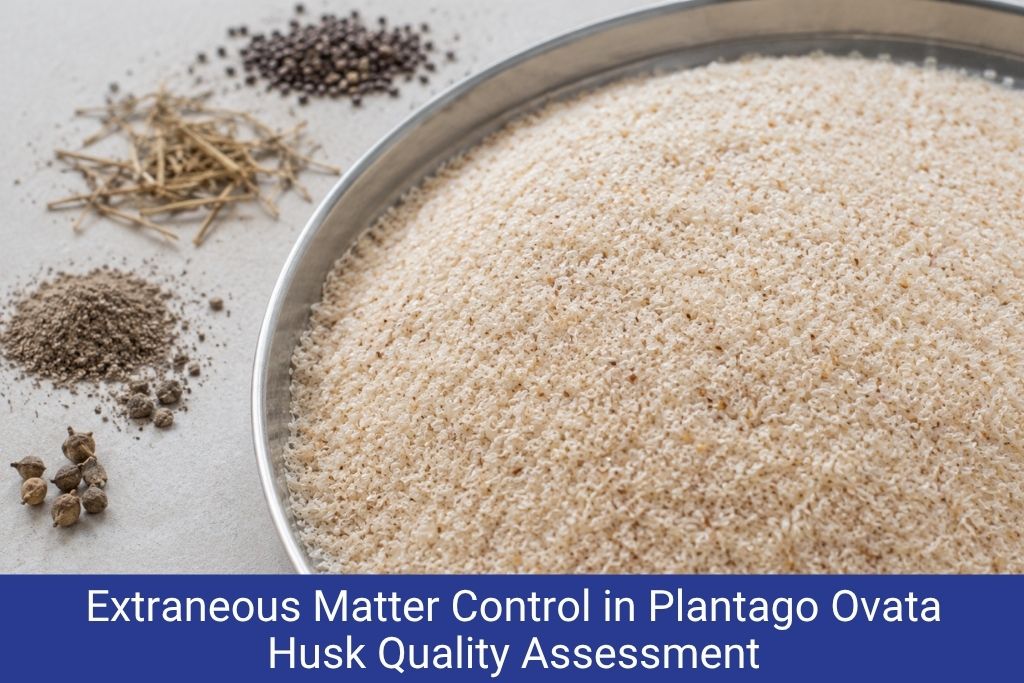
Extraneous matter divides into light material, meaning chaff, fiber fragments, and plant debris, and heavy material, meaning sand, stones, and mineral contamination, and pharmacopeia standards cap both because they compromise purity and safety of Plantago ovata husk. Light extraneous matter typically arises from incomplete separation of husk from surrounding plant material, while heavy extraneous matter enters from field soil and handling, and each requires different removal technology.
Gravity separation and air classification remove light debris by density and airflow, while destoning equipment separates heavy mineral contamination, together bringing material within the tight limits that pharmaceutical and food grade specifications demand. These parameters matter beyond aesthetics because sand and stones damage processing equipment, create gritty mouthfeel in finished products, and represent contamination that regulatory standards specifically limit. Buyers serving pharmaceutical and premium supplement markets enforce strict extraneous matter tolerances and test incoming material against them. Suppliers with complete cleaning infrastructure consistently meet these limits, while basic processors relying on simpler methods struggle to remove fine contamination reliably. Clean husk with minimal extraneous matter signals both quality and the processing capability that demanding buyers require. Cleanliness here underpins the purity and safety the rest of the specification assumes.
Our Other Product
Psyllium Kha Kha PowderMicrobial Load: Meeting Pharmacopeia Limits for Psyllium Fiber
Microbial load must meet the limits set by USP and EP monographs, covering total plate count, yeast and mold, E coli, and Salmonella, because psyllium fiber enters pharmaceuticals and supplements consumed by vulnerable populations. Raw psyllium can carry microbial contamination from field, handling, and processing exposure, so achieving pharmacopeia compliance requires both hygienic processing and, for the strictest specifications, sterilization treatment. Sterilized psyllium fiber options serve buyers whose formulations demand the lowest microbial counts, particularly pharmaceutical bulk laxatives and infant or clinical nutrition applications where pathogen absence is non negotiable. Testing must confirm compliance on each lot, since buyers require microbiological certificates matching their monograph or internal specifications before releasing material to production. Suppliers who maintain hygienic facilities, control moisture to suppress microbial growth, and offer validated sterilization when needed access the pharmaceutical grade market that commands premium pricing. Buyers should specify their microbial requirements precisely, distinguishing between food grade and pharmacopeia grade limits, since the gap between them is substantial. Microbial control, invisible in the finished powder’s appearance, is among the most important safety parameters and separates true pharmaceutical suppliers from general food processors. It directly protects the health of end consumers.
Heavy Metals: Lead, Arsenic, Cadmium, and Mercury Testing
Heavy metal analysis for lead, arsenic, cadmium, and mercury is mandatory for psyllium entering supplement and pharmaceutical channels, driven by regulations including California Proposition 65, EU limits, and pharmacopeia standards. Plants absorb heavy metals from soil and water, so contamination risk depends on growing region conditions, making source control and testing essential rather than optional for export grade material.
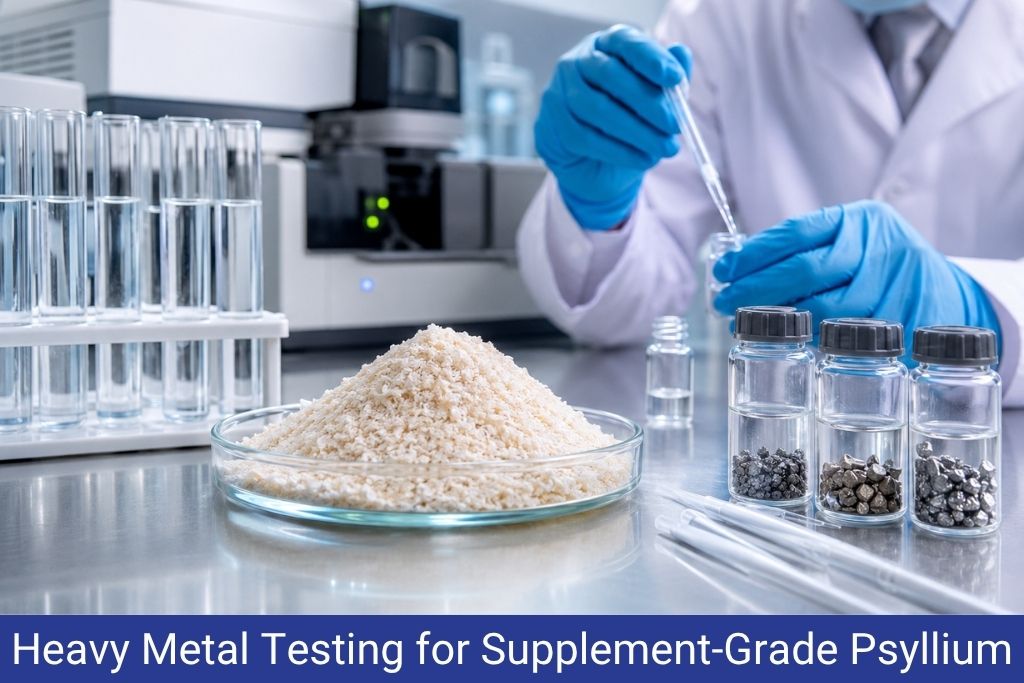
Supplement regulations in developed markets require documented heavy metal results on every lot, and Prop 65 in particular imposes such low thresholds that products failing it face litigation and delisting in the American market. Buyers therefore demand batch specific heavy metal certificates and often commission independent verification testing before accepting shipments. Suppliers sourcing from monitored growing regions and testing systematically deliver compliant material consistently, while those without source control and analytical capability risk shipping contaminated lots that fail at destination. Because heavy metals cannot be removed from finished husk, prevention through sourcing and screening is the only viable approach. Buyers should treat heavy metal documentation as a non negotiable requirement and verify that supplier certificates come from accredited laboratories. This parameter directly determines market access for supplement and pharmaceutical applications.
Pesticide Residues: MRL Compliance for Organic Psyllium Husk Buyers
Pesticide residue compliance requires conventional psyllium to meet destination maximum residue limits, while organic psyllium husk demands certified residue free supply chains verified through NPOP, NOP, or EU organic certification. Although psyllium is a relatively low input crop, residues from field application or cross contamination can still exceed the tight MRLs that developed markets enforce, so screening protects buyers from rejection. Organic buyers represent a large and growing segment, since psyllium’s health positioning aligns naturally with organic consumer values, and they require full certification chains proving the material was grown and processed without prohibited inputs. Certification involves inspected organic farms, segregated processing, and documented traceability from field to finished bag, infrastructure that only committed organic suppliers maintain. Conventional buyers still require MRL compliance certificates matched to their destination market, since limits differ between jurisdictions. Suppliers operating both certified organic and residue monitored conventional lines serve the full market spectrum, and their testing discipline distinguishes them from traders who cannot guarantee compliance. Buyers should specify whether they need organic or conventional material and require appropriate certification and residue documentation accordingly. Pesticide compliance increasingly gates access to premium psyllium markets.
Color and Appearance: Visual Standards for Premium Psyllium Husk
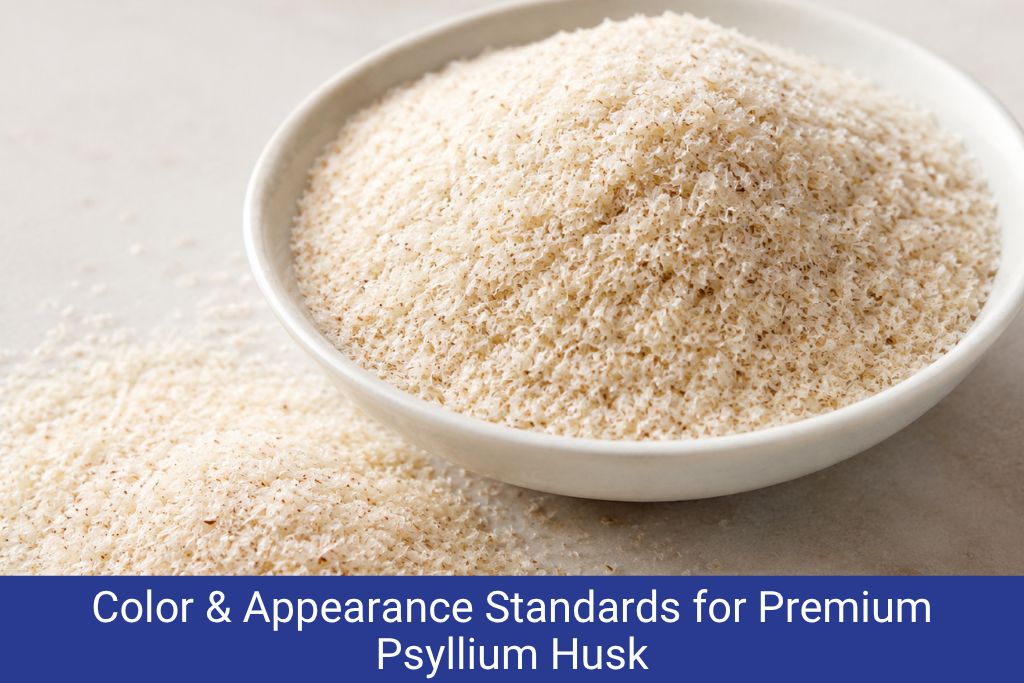
Color and appearance provide an immediate visual quality signal, with export grade husk appearing pinkish white to light beige with uniform, clean flakes, while dark specks, brown discoloration, or gray tones indicate poor processing, contamination, or aged stock. Fresh, properly processed Plantago ovata husk carries a characteristic light color that experienced buyers recognize instantly, and deviation from it prompts closer scrutiny of purity, moisture, and freshness.
Discoloration can arise from excessive fines, incomplete separation of seed material, moisture exposure, or simply old inventory whose color has degraded over storage. While appearance is not itself a safety parameter, it correlates strongly with the underlying quality attributes buyers actually care about, functioning as a quick proxy that flags lots warranting deeper testing. Premium buyers reject visually poor material even before laboratory analysis, treating appearance as a legitimate quality gate. Suppliers who maintain fresh stock rotation, control processing carefully, and separate fines effectively present the clean, uniform, light colored husk that premium markets expect. Buyers should establish visual standards in their specifications and inspect samples, since appearance provides valuable information at a glance. Consistent color signals consistent quality throughout the supply chain.
Our Other Product
Ashwagandha PowderGluten and Allergen Status: Clean Label Assurance for Buyers
Gluten and allergen status matters critically because psyllium’s largest growth market is gluten free bakery, where it replaces gluten’s structural function, and buyers require confirmation of both natural gluten free status and allergen control programs. Psyllium is naturally gluten free, making it invaluable to gluten free product formulators who use its water binding gel to structure breads and baked goods that would otherwise crumble, but buyers still demand gluten testing to confirm no cross contamination occurred during processing. Allergen control programs at the processing facility prevent contamination from other products handled in shared equipment, and clean label buyers increasingly audit these programs before contracting. The gluten free market’s rapid growth, worth billions globally, has made psyllium a strategic ingredient rather than a commodity for many bakery buyers, raising the importance of documented gluten free assurance. Suppliers who test for gluten, maintain allergen segregation, and provide clean label documentation access this premium application, while those who cannot risk exclusion from the fastest growing psyllium market. Buyers should require gluten free certification and allergen statements for these applications. This parameter connects psyllium’s functional properties to the specific clean label demands of modern food manufacturing.
Get Bulk Psyllium, Spices & Grains QUOTES TODAY!

How Giriraj Enterprise Certifies Every Psyllium Husk Quality Parameter
- In house cleaning, milling, and sieving delivering purity grades up to 99 percent with consistent swell volume above 40 milliliters per gram
- Batch wise Certificates of Analysis covering purity, swell volume, moisture, extraneous matter, microbiology, and heavy metals
- NABL accredited third party testing available on request for buyers requiring independent verification
- Whole husk, psyllium husk powder across multiple mesh grades, and industrial grades produced from one integrated facility
- Certified organic and residue monitored conventional supply chains with full traceability to Gujarat and Rajasthan farms
- Export packing in 25 kilogram paper bags with food grade moisture barrier liners protecting material through humid transit
Frequently Asked Questions
What purity of psyllium husk is best for pharmaceutical use?
Pharmaceutical and supplement buyers should specify 98 or 99 percent purity psyllium husk, since their formulations and regulatory filings depend on consistent high functionality material that lower grades cannot reliably provide.
What is a good swell volume for psyllium husk?
Swell volume of 40 milliliters per gram or higher indicates premium functional quality. This single measurement predicts laxative efficacy, gluten free baking performance, and fiber beverage mouthfeel more directly than any other parameter.
What is the difference between psyllium husk and psyllium husk powder?
Husk is the whole flaked outer seed coat of the Plantago ovata plant, suited to supplement flakes and traditional use, while powder is the same husk milled to finer mesh grades for baking, beverages, capsule filling, and pharmaceutical formulation.
Why is Indian psyllium considered the best in the world?
India’s Gujarat and Rajasthan belts provide the ideal arid growing conditions psyllium requires, and Indian processors supply over 80 percent of global demand with established pharmacopeia grade processing knowledge built over generations.
Can Giriraj Enterprise provide a Certificate of Analysis with each shipment?
Yes. Every batch from Giriraj Enterprise ships with a complete Certificate of Analysis covering purity, swell volume, moisture, extraneous matter, microbial, and heavy metal parameters, with independent NABL testing available on request.

Mihir Shah is the CEO of Giriraj Enterprise, a trusted manufacturer, supplier, and exporter of Psyllium products, whole spices, ground spices, herbal products, guar gum and other agro products like Quinoa Seeds, Chia Seeds including Isabgol, Plantago ovata Seeds, Ispaghula Husk Powder and Kha Kha Powder. Founded in 1973 and based in Unjha, Gujarat, Giriraj Enterprise has grown significantly under Mihir’s leadership, establishing itself as a trusted name in the global market. With a focus on high-quality standards and adherence to international food norms, the company serves a wide customer base across the globe.
A strategic thinker with a passion for sustainable growth, Mihir has played a pivotal role in expanding the company’s production capacity, which now stands at 3,000 quintals per month, and in ensuring that Giriraj Enterprise remains at the forefront of innovation in the industry. His commitment to quality is reflected in the company’s stringent in-house quality testing and third-party verification, ensuring that all products meet the highest standards of excellence. He is dedicated to driving customer satisfaction by offering fast, reliable services both domestically and internationally.
Through his writing, Mihir shares valuable insights and knowledge about Psyllium, spices, herbal and other agro products, educating readers on their benefits and the role they play in promoting health and well-being. His goal is to provide factual, transparent information to help consumers and businesses make informed decisions.