



AI Summary
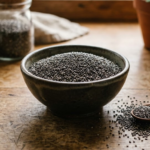
The top 10 emerging markets for Indian chia seed export are the United States, Germany, the United Arab Emirates, the United Kingdom, Australia, Japan, South Korea, Saudi Arabia, the Netherlands, and Canada. Indian chia cultivation across Madhya Pradesh, Karnataka, and Rajasthan now offers importers a cost effective alternative to Latin American origin with shorter transit to Asia and the Gulf. Global search interest for chia exceeds 1.8 million monthly queries, driven by the omega 3, fiber, and protein benefits of chia seeds. Giriraj Enterprise supplies sortex cleaned black chia seeds at 99.9 percent purity with moisture below 8 percent in bulk and private label packing to all these destinations, plus consolidated shipments with quinoa, psyllium, and whole spices.
Introduction
Chia is the most searched superfood seed in the world, with global interest exceeding 1.8 million monthly queries, driven by consumer awareness of its exceptional omega 3, soluble fiber, and complete protein content, the benefits of chia seeds that have propelled it from obscurity to supermarket ubiquity within a decade. Mexico, Bolivia, and Paraguay pioneered commercial supply, but their price volatility and long shipping routes to Asian and Middle Eastern markets created space for new origins. Indian chia cultivation expanded rapidly to fill this gap, with farming across Madhya Pradesh, Karnataka, and Rajasthan, and Indian chia seed exporters now compete globally on price, freshness, and logistics, particularly for buyers in Asia and the Gulf who benefit from India’s proximity. For importers and exporters alike, understanding which markets are emerging, why they are growing, and what each demands is the foundation of a successful chia strategy. This article covers both the top emerging markets and the leading countries importing chia seeds from India, since they substantially overlap. These ten destinations represent where Indian chia demand is growing fastest.



United States: The Biggest Destination for Chia Seed Wholesale
The United States is the largest destination for chia seed wholesale, with American smoothie, pudding, snack bar, and beverage brands buying in full container volumes to serve the country’s enormous health food market. Chia’s mainstream American adoption, spanning chia pudding, overnight oats, chia beverages, and snack products, creates broad and deep demand that Indian origin increasingly serves on the strength of landed cost advantages over Latin American material. US buyers require FDA facility registration, prior notice filing, and clean Certificates of Analysis covering pesticides, heavy metals, and microbiology, and they convert successful trial orders into annual contracts once quality is proven. The scale of American chia consumption, driven by both retail and food manufacturing, makes it the anchor market for any serious Indian chia export operation. Buyers here value consistent 99.9 percent purity, uniform black seed color, and reliable supply, since their finished products depend on ingredient consistency. Indian suppliers offering FDA compliance, clean documentation, and competitive pricing win share from established origins. As American chia demand continues growing across retail and industrial channels, and as buyers seek supply diversification against Latin American volatility, the US remains the single most important market for Indian chia exporters.
Germany: Organic Chia Seeds Gateway to the European Union
Germany serves as the organic chia seeds gateway to the entire European Union, combining Europe’s largest organic retail market with its role as a continental distribution hub. German importers buy certified organic chia under EU organic standards and EU Novel Food compliance, then redistribute across the continent from Hamburg, making Germany a high volume market even beyond its substantial domestic consumption. The German organic sector’s scale and its consumers’ strong preference for certified organic products drive demand for organic Indian chia, requiring suppliers to hold EU organic certification backed by traceable organic supply chains.
German buyers test rigorously against EU pesticide maximum residue limits and reject any material outside specification, so passing German scrutiny effectively credentials a supplier across Europe. The Novel Food regulation, which governs chia’s approved uses and maximum inclusion levels in the EU, adds a compliance dimension that German importers manage carefully. Volume contracts typically run annually, giving qualified suppliers predictable demand. For Indian chia exporters, Germany represents both a demanding quality gate and a gateway to the broader European market, and suppliers who meet its organic and residue standards access continental distribution through a single strong German relationship.
United Arab Emirates: Gulf Demand for Black Chia Seeds
The United Arab Emirates anchors Gulf demand for black chia seeds, with Dubai importers stocking chia for regional supermarkets, health cafes, and re export across the GCC and East Africa. The UAE’s affluent, health conscious, and heavily expatriate population adopted chia early, and it now appears routinely across supermarket health aisles, cafe menus, and wellness products throughout Dubai and Abu Dhabi. Indian suppliers hold a decisive logistics advantage here, with transit from Indian ports to Jebel Ali completing in just five to seven days, letting Gulf importers run lean inventories and replenish quickly, a stark contrast to the weeks required for Latin American material. Halal certification is standard, and Dubai’s role as a regional trading hub means chia imported through the UAE flows onward to Saudi Arabia, other Gulf states, and African markets. Ramadan and the winter season create predictable demand peaks that experienced exporters plan around. For Indian chia suppliers, the UAE frequently serves as an accessible first export market where new processors prove their capabilities, and its combination of strong local demand and re export function makes it a consistently important destination with growing volumes.
United Kingdom: Functional Food Buyers of Omega 3 Rich Chia
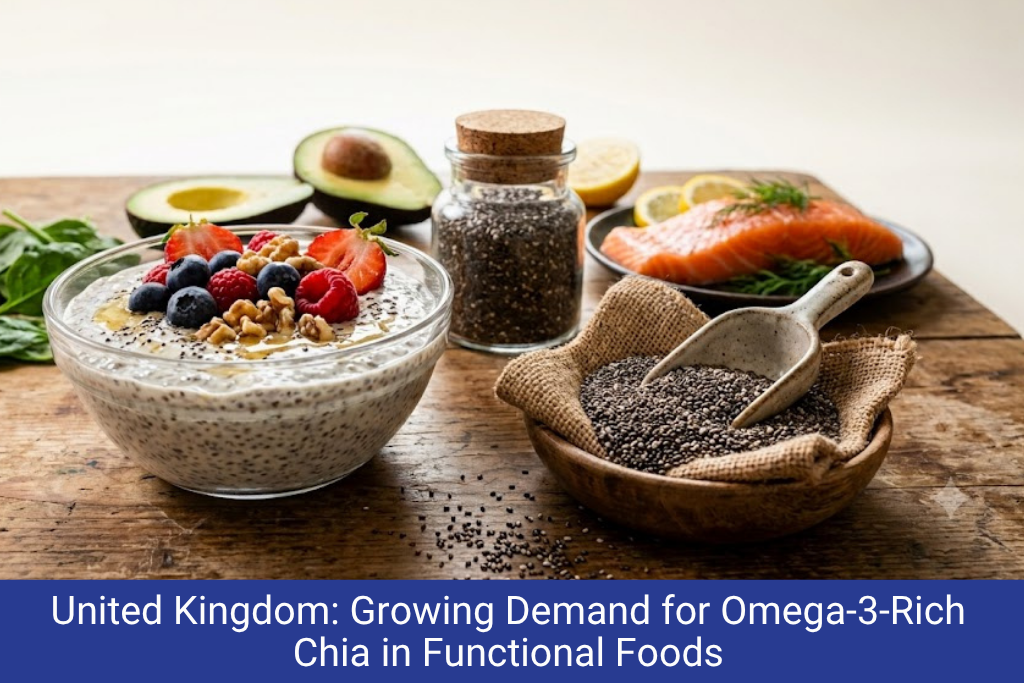
The United Kingdom hosts substantial functional food demand for omega 3 rich chia, with British breakfast, bakery, and beverage brands formulating chia into products marketed for its nutritional benefits. UK food manufacturers use chia across breakfast products, bread and bakery items, snack bars, and beverages, drawing on its omega 3, fiber, and protein content to support health claims that differentiate their products in a health conscious market. British buyers favor suppliers who provide nutritional analysis with every lot, since their finished product claims depend on documented chia composition, alongside standard food safety documentation.
Post Brexit customs independence means UK importers increasingly contract Indian suppliers directly rather than sourcing through EU distributors, shortening the supply chain and improving margins. The UK gluten free and health food markets, both substantial, incorporate chia widely, and retail demand for bagged chia seeds adds to industrial demand. Buyers value consistent purity, uniform seed quality, and reliable supply for their formulations. As UK functional food and health product manufacturing continues incorporating chia, and as direct sourcing from India grows post Brexit, the UK represents an important and expanding market where Indian suppliers offering documentation depth and direct trade capability capture growing demand.
Our Other Product
Dill SeedAustralia: Quality Conscious Imports of Sortex Cleaned Chia Seeds
Australia imports substantial volumes of sortex cleaned chia seeds despite domestic cultivation, driven by quality conscious buyers and strict biosecurity requirements that favor professional suppliers. While Australia grows some chia, domestic production cannot meet national demand, leaving import requirements that Indian suppliers increasingly fill alongside other origins. Australian biosecurity is among the world’s strictest, requiring fumigation certificates, phytosanitary documentation, and clean inspection compliance, so buyers work only with established exporters holding clean records, a barrier that filters out casual traders. Australian buyers expect high purity, typically 99.9 percent sortex cleaned material with uniform seed quality, reflecting the market’s premium positioning and consumer expectations. The strong Australian health food sector, spanning mainstream grocery and a dense independent health channel, incorporates chia across products and retail, sustaining steady demand. Australian consumers pay premium prices, supporting healthy import margins despite the compliance overhead. For Indian chia exporters, passing Australian biosecurity and meeting its quality expectations credentials them for other demanding markets. As Australian chia demand continues, and as buyers value the quality and biosecurity compliance professional Indian suppliers deliver, Australia represents a premium market rewarding suppliers who meet its exacting standards.
Japan: Premium Market for Chia in Beverages and Desserts
Japan represents a premium market for chia in beverages and desserts, where Japanese food companies suspend chia in drinks and dessert products demanding exceptional quality and consistency. Japanese applications, including chia beverages where the seeds are suspended in liquid and dessert products showcasing the hydrated seeds, require uniform seed size, high mucilage gel strength for proper suspension and texture, and impeccable microbial results, since any inconsistency shows in these visible applications.
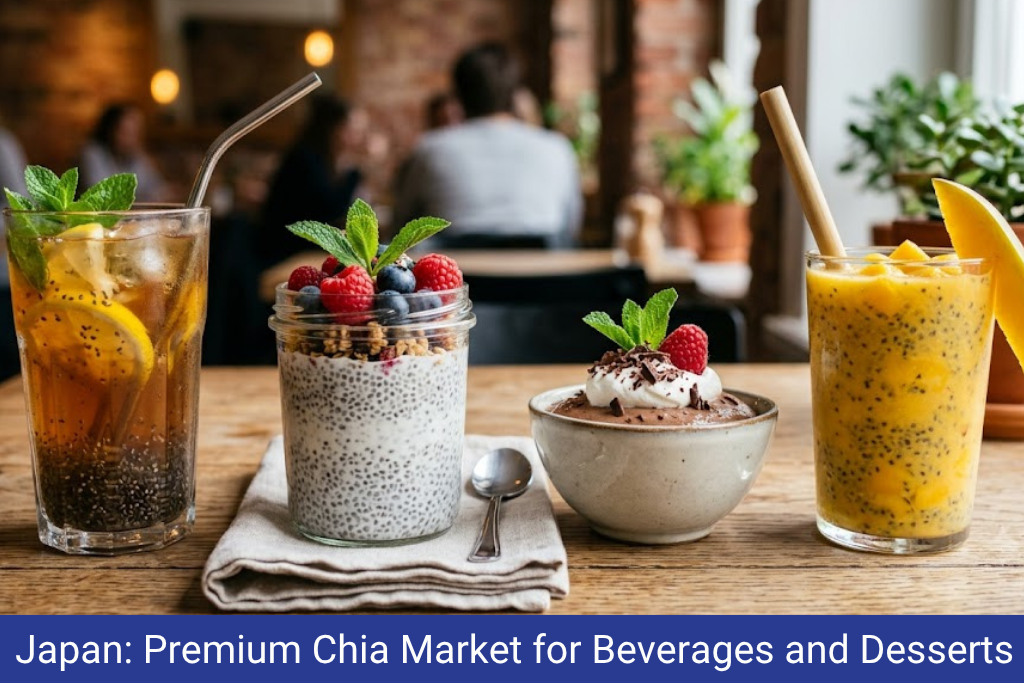
Japanese buyers apply meticulous scrutiny, beginning with small trial lots subjected to extensive internal testing before scaling to larger commitments, so Indian exporters need patience and flawless consistency to establish Japanese relationships. Testing under Japan’s positive list pesticide system covers hundreds of compounds, and documentation expectations are comprehensive. The reward structure compensates for the rigor: Japanese contracts run for years with minimal price pressure once trust is established, and Japanese qualification signals quality to buyers worldwide. Indian chia’s freight advantage over Latin America is meaningful here, cutting weeks from replenishment. For Indian suppliers willing to meet Japan’s exacting standards through patient qualification, this market offers premium pricing and exceptional loyalty, making it a valuable if demanding destination that rewards quality focused exporters.
South Korea: K Wellness Trend Driving Superfood Seed Imports
South Korea’s K wellness trend drives growing superfood seed imports, with Korean meal replacement, inner beauty, and functional food brands adding chia to their products. Korean consumers, particularly younger demographics embracing convenient functional nutrition, incorporate chia into meal replacement shakes, yogurt toppers, inner beauty products, and health foods, making South Korea one of Asia’s fastest growing superfood seed importers. The K wellness movement, blending nutrition, beauty, and convenience, has embraced chia as a functional ingredient fitting its health focused product formulations. Korean buyers apply careful quality standards, often auditing foreign suppliers through document reviews and video inspections before contracting, and requiring material meeting their regulatory and quality specifications. Orders may specify particular seed characteristics for smooth incorporation into beverages and functional foods, along with strict microbial limits reflecting long product shelf lives. As Korean functional food, meal replacement, and beauty from within categories continue their rapid growth, chia demand rises correspondingly. Indian suppliers who support Korean documentation requirements and deliver consistent quality access this expanding, high value market. South Korea’s combination of fast growth, quality focus, and premium positioning makes it an attractive emerging destination for Indian chia exporters building Asian market presence.
Saudi Arabia: Health Retail Expansion Importing Chia Seeds from India
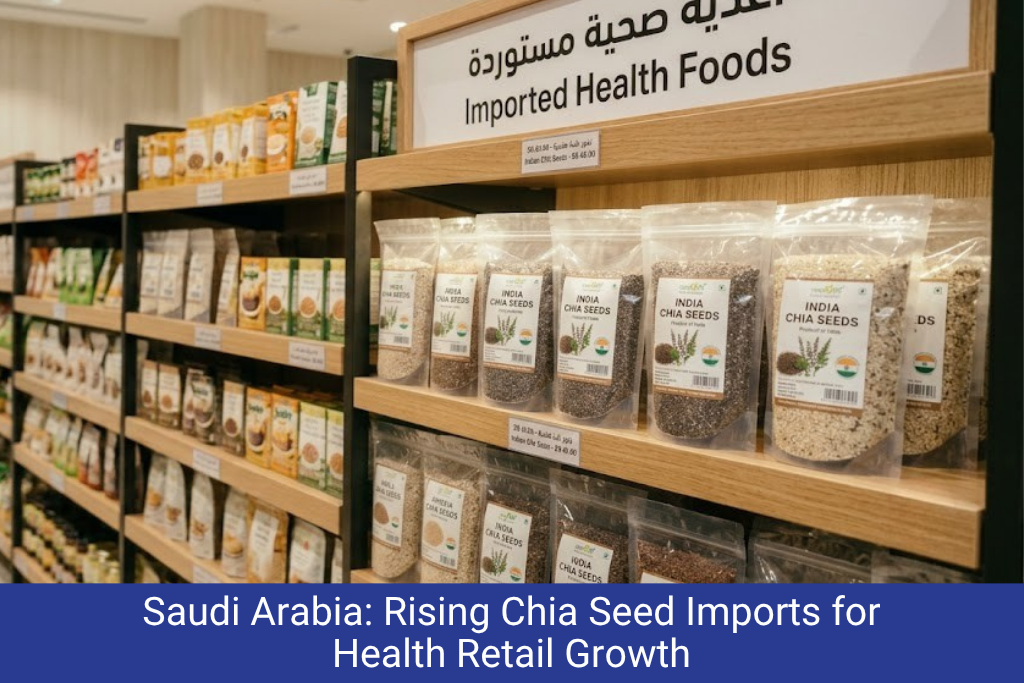
Saudi Arabia’s health retail expansion is increasingly importing chia seeds from India, driven by rising health awareness, government wellness initiatives, and a young urban population embracing superfoods. Saudi supermarkets and pharmacies now carry chia prominently, and the kingdom’s health conscious consumers, influenced by social media food culture and expanding healthy dining, adopt chia across retail and food service. Saudi Vision 2030 wellness initiatives and rising health literacy reinforce this trend, translating into growing retail velocity for chia and related superfoods.
Importers historically sourced through Dubai consolidators, but larger Saudi distributors increasingly contract Indian chia suppliers directly to capture margin and secure supply, a structural shift favoring exporters ready to manage Saudi FDA registration, SASO conformity, and Arabic labeling. Halal certification is assumed. The institutional catering segment serving schools, hospitals, and corporate campuses adds tender based volume atop retail growth. With per capita chia consumption still far below western levels and high disposable income, Saudi Arabia offers Indian exporters strong growth potential. As health retail expands and direct sourcing from India grows, Saudi Arabia represents one of the most promising emerging markets, and suppliers managing its documentation requirements access rising demand in this large, affluent market.
Our Other Product
Nutmeg PowderNetherlands: European Distribution Hub for Bulk Chia Seed Supply
The Netherlands functions as a European distribution hub for bulk chia seed supply, with Rotterdam traders contracting Indian chia annually for repacking into Scandinavian and Benelux retail chains. Dutch trading companies buy full containers, warehouse material in bonded facilities, and break bulk into retail and food service formats under numerous European brands, making the Netherlands a consistent high volume buyer even beyond its domestic consumption. This distribution function means a single strong Dutch relationship can place Indian chia on shelves across multiple European countries, multiplying the value of the connection. Dutch buyers are commercially sophisticated negotiators who nonetheless order predictably and pay reliably, making them valuable baseline volume customers. Technical requirements center on EU pesticide MRL compliance, EU Novel Food adherence, moisture control for warehouse stability, and consistent purity, with documentation expected complete on first presentation. Several Rotterdam houses operate repacking facilities serving dozens of European brands, so Dutch relationships offer broad market reach. For Indian chia exporters seeking steady European volume to balance demand elsewhere, Dutch distribution partners provide dependable year round offtake, and the Netherlands’ role as Europe’s trading floor makes it a strategically important market connecting Indian supply to broad continental distribution.
Canada: Clean Label Market Comparing Quinoa vs Chia Sourcing
Canada represents a clean label market where buyers often evaluate quinoa vs chia consolidation from a single supplier, and Indian exporters offering both in mixed containers win this efficiency driven business. Canadian brands and food manufacturers use chia enthusiastically, supported by strong plant based eating trends and a health conscious population, incorporating it across cereals, snack bars, beverages, and bakery products. Because many Canadian buyers source multiple health seeds and grains, the ability to buy chia and quinoa together from one Indian supplier consolidates containers, reduces per unit freight, and simplifies procurement, giving suppliers offering both a competitive advantage. Canadian buyers apply clean label scrutiny, demanding non GMO declarations, allergen statements, complete traceability, and thorough safety documentation, while Health Canada import rules require standard food safety compliance. Buyers value consistent 99.9 percent purity, uniform black chia, and reliable supply for their formulations. Toronto and Vancouver importers often serve both Canadian retail and cross border US customers, multiplying relationship value. As Canadian chia demand grows across plant based and health product manufacturing, and as buyers seek sourcing efficiency, Canada represents an important market where Indian suppliers offering both chia and quinoa with clean documentation capture consolidation driven demand.
Why Global Importers Choose Giriraj Enterprise as Their Chia Seed Exporter
- Sortex cleaned black chia seeds at 99.9 percent purity with uniform size and consistent color
- Moisture controlled below 8 percent for safe transit and extended shelf life across climate zones
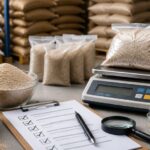
- Batch testing for pesticide residues, heavy metals, and microbiology with Certificates of Analysis per shipment
- Certified organic and conventional supply options with traceability to Indian farms
- Private label chia seeds in retail pouches plus 25 kilogram bulk export bags with custom branding
- Mixed container consolidation combining chia with quinoa, psyllium, and whole spices to reduce importer freight costs
Frequently Asked Questions
Does India export chia seeds?
Yes. India has become a significant chia origin, with cultivation across Madhya Pradesh, Karnataka, and Rajasthan supplying growing export volumes worldwide, offering cost and logistics advantages over traditional Latin American sources.
Which countries import chia seeds from India?
The leading countries importing chia seeds from India are the USA, Germany, the UAE, the UK, Australia, Japan, South Korea, Saudi Arabia, the Netherlands, and Canada, with Gulf and Asian markets growing fastest on India’s proximity advantage.
How does Indian chia compare with Mexican chia?
Properly cleaned Indian chia matches international purity and nutritional standards while offering lower pricing and substantially faster shipping to Asian and Middle Eastern buyers, giving it strong competitiveness against Latin American origin.
What purity should buyers specify for chia seed imports?
International buyers typically specify 99.9 percent purity, sortex cleaned, with moisture below 8 percent and uniform black seed color, ensuring consistent quality for beverages, puddings, bakery, and other applications.
Can Giriraj Enterprise supply private label chia seeds?
Yes. Giriraj Enterprise packs private label chia seeds with custom branding alongside bulk chia seed wholesale supply, and offers mixed container consolidation with quinoa, psyllium, and whole spices to reduce importer freight costs.

Mihir Shah is the CEO of Giriraj Enterprise, a trusted manufacturer, supplier, and exporter of Psyllium products, whole spices, ground spices, herbal products, guar gum and other agro products like Quinoa Seeds, Chia Seeds including Isabgol, Plantago ovata Seeds, Ispaghula Husk Powder and Kha Kha Powder. Founded in 1973 and based in Unjha, Gujarat, Giriraj Enterprise has grown significantly under Mihir’s leadership, establishing itself as a trusted name in the global market. With a focus on high-quality standards and adherence to international food norms, the company serves a wide customer base across the globe.
A strategic thinker with a passion for sustainable growth, Mihir has played a pivotal role in expanding the company’s production capacity, which now stands at 3,000 quintals per month, and in ensuring that Giriraj Enterprise remains at the forefront of innovation in the industry. His commitment to quality is reflected in the company’s stringent in-house quality testing and third-party verification, ensuring that all products meet the highest standards of excellence. He is dedicated to driving customer satisfaction by offering fast, reliable services both domestically and internationally.
Through his writing, Mihir shares valuable insights and knowledge about Psyllium, spices, herbal and other agro products, educating readers on their benefits and the role they play in promoting health and well-being. His goal is to provide factual, transparent information to help consumers and businesses make informed decisions.