





July 8, 2026
Mihir Shah
Share At:
Google AI ChatGPT Grok Perplexity

AI SUMMARY

Plantago ovata, commercially known as psyllium or isabgol, is covered by three major international pharmacopeias: the United States Pharmacopeia (USP), the British Pharmacopoeia (BP), and the Indian Pharmacopoeia (IP). Each monograph defines specific tests for identity, purity, swelling index, and limits for contaminants. Manufacturers exporting psyllium products to regulated markets must align production and quality control with the relevant compendium. This article explains the key requirements of each monograph, the differences between them, and what Indian manufacturers need to do to achieve compliance.

Introduction: Why Pharmacopeial Compliance Is Non-Negotiable

When Plantago ovata derivatives – seeds, husks, and husk powder – are used in pharmaceutical products, they must comply with the monograph specifications of the relevant national or regional pharmacopeia. For exporters, this means understanding not one but potentially three overlapping frameworks: the USP (for North America), the BP (for UK and Commonwealth markets), and the IP (for India and South Asian markets).

Non-compliance with psyllium pharmacopeia standards can result in import refusals, regulatory citations, product recalls, and damage to supplier relationships. For manufacturers targeting regulated pharmaceutical or nutraceutical markets globally, monograph compliance is a fundamental commercial requirement.

Overview: What Do Pharmacopeial Monographs Cover?

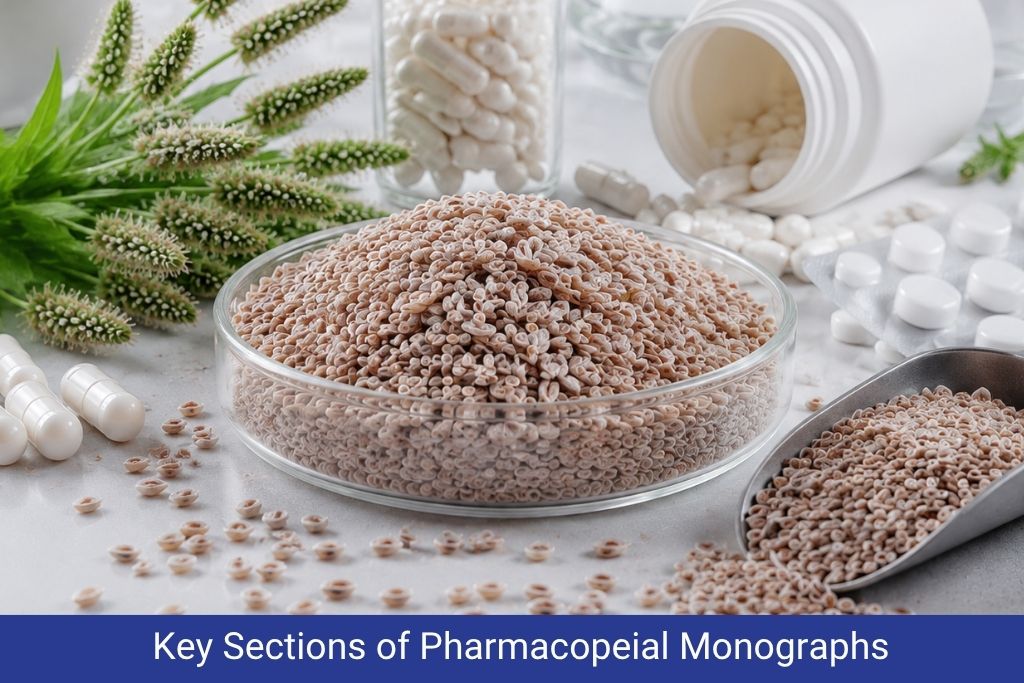
Pharmacopeial monographs for botanical ingredients typically include the following sections:

  • Definition and source – botanical origin, plant part used, and preparation method
  • Identification tests – macroscopic and microscopic characteristics, chemical tests
  • Tests for purity – foreign matter, total ash, acid-insoluble ash
  • Functional test – swelling index or swell volume
  • Limits for contaminants – pesticide residues, heavy metals, aflatoxins
  • Microbial limits – total aerobic count, yeasts and moulds, absence of specified pathogens
  • Labelling and storage requirements

Each pharmacopeia has its own testing methodology, acceptable limits, and nomenclature, which creates compliance complexity for manufacturers serving multiple markets simultaneously.

Get Your Custom Bulk Order Quote! Contact Us

Message us on WhatsApp

WhatsApp

Bulk Order

Plantago Ovata in the United States Pharmacopeia (USP)

Monograph Coverage and Nomenclature

The USP covers Plantago ovata under several monographs depending on the product form. The primary monographs relevant to manufacturers are:

  • Psyllium Husk (Ispaghula Husk) – the cleaned, dried seed coat of Plantago ovata
  • Powdered Psyllium Husk – processed from the above to defined particle size

The USP uses the term ‘psyllium’ as the primary label name, with ‘ispaghula’ recognized as a synonym for international harmonization purposes.

USP Key Requirements

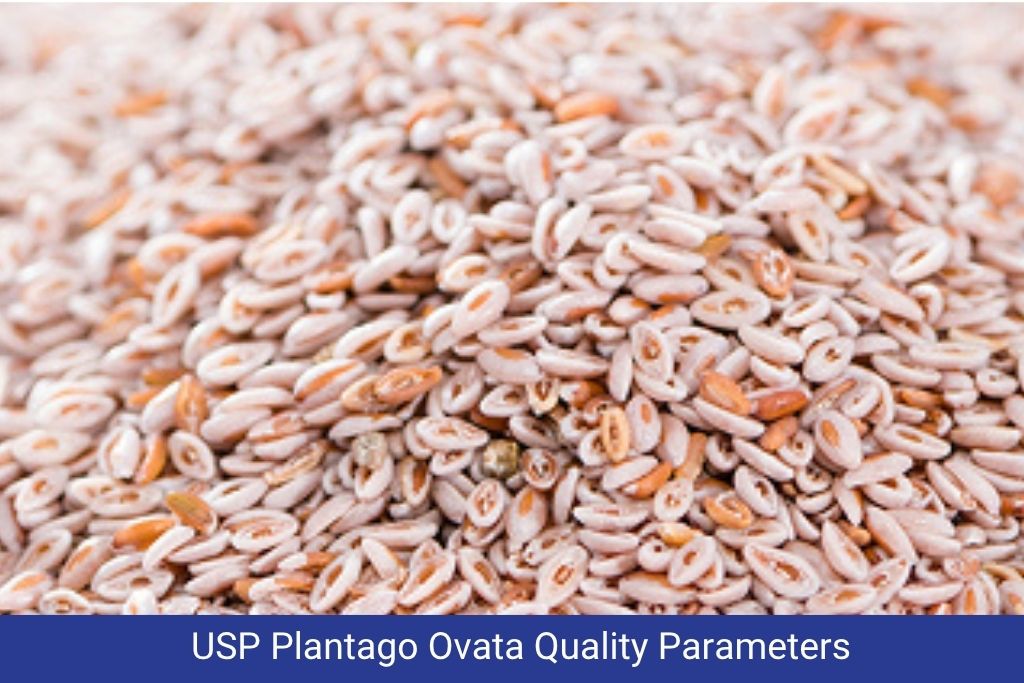
The USP Plantago Ovata USP monograph specifies the following critical parameters:

  • Identity: Organoleptic characteristics and microscopy confirming Plantago ovata origin
  • Swelling power: Not less than 40 mL per gram (for husk); tested using the IP/BP swelling index method adapted to USP
  • Total ash: Not more than 4%
  • Acid-insoluble ash: Not more than 1%
  • Loss on drying: Not more than 12%
  • Pesticide residues: Compliant with USP <561> Pesticide Residue Limits in Botanicals
  • Heavy metals: Compliant with USP <232>/<233> Elemental Impurities
  • Microbial enumeration: Per USP <2021>

For manufacturers supplying psyllium to the US dietary supplement market (regulated under DSHEA) or OTC drug market, USP monograph compliance is the gold standard expected by buyers and FDA-regulated facilities.

Plantago Ovata in the British Pharmacopoeia (BP)

Monograph Coverage and Nomenclature

The British Pharmacopoeia uses the term ‘Ispaghula Husk’ as the primary monograph name, reflecting the traditional nomenclature prevalent in the UK and Commonwealth markets. The BP monograph covers:

  • Ispaghula Husk – dried seed coats of Plantago ovata
  • Ispaghula Husk Powder – from the above, reduced to fine or very fine powder

BP Key Requirements

The isabgol IP BP standard has important distinctions from the USP. Key BP specifications include:

  • Swelling index: Not less than 40 mL per gram – tested per BP swelling index method
  • Foreign matter: Not more than 2%
  • Total ash: Not more than 4%
  • Acid-insoluble ash: Not more than 1%
  • Sulphated ash: Additional test not present in USP
  • Loss on drying: Not more than 12%
  • Pesticide residues: Per BP Appendix XI L
  • Aflatoxins: BP specifies limits for aflatoxin B1, G1, G2 – a more explicit requirement than USP
  • Microbial contamination: Per BP Appendix XVI B2

A key practical distinction: the BP’s aflatoxin testing requirement is often cited as a significant barrier for Indian exporters to UK and EU markets. Manufacturers must validate their supply chain for aflatoxin control, particularly during storage and transport.

Connect with Us for Export Deals! Contact Us

Message us on WhatsApp

WhatsApp

Contact us

Plantago Ovata in the Indian Pharmacopoeia (IP)

Monograph Coverage and Nomenclature

The Indian Pharmacopoeia – the domestic standard published by the Indian Pharmacopoeia Commission (IPC) – uses ‘Ispaghula Husk’ and ‘Plantago Ovata Seeds’ as the primary monograph terms. Given that India is the world’s largest psyllium producer, the IP monograph has direct relevance for domestic pharmaceutical manufacturers and as a baseline for export quality.

IP Key Requirements

The isabgol IP BP standard in the Indian Pharmacopoeia includes:

  • Botanical identity: Macroscopic and microscopic identification confirming Plantago ovata
  • Swelling index: Not less than 40 per gram (Note: IP expresses swelling index differently from BP’s mL/g notation – manufacturers must verify test method alignment)
  • Foreign matter: Not more than 2%
  • Total ash: Not more than 4%
  • Acid-insoluble ash: Not more than 1%
  • Loss on drying: Not more than 12%
  • Pesticide residues: Per IP general chapter
  • Assay: IP includes an assay for water-soluble extractive value

The IP monograph also provides guidance on storage – protecting from moisture, light, and infestation – which has practical implications for warehouse management at manufacturing facilities in Gujarat.

Whole Spices

Comparative Overview: USP vs BP vs IP - Key Differences

Parameter

USP

BP

IP

Primary Name

Psyllium Husk

Ispaghula Husk

Ispaghula Husk

Swelling Index

≥40 mL/g

≥40 mL/g

≥40 per g

Total Ash Limit

≤4%

≤4%

≤4%

AIA Limit

≤1%

≤1%

≤1%

Aflatoxin Testing

Via <561>

Explicit limits

Per general chapter

Sulphated Ash

Not specified

Required

Not specified

Primary Market

USA, Canada

UK, Commonwealth, EU

India, South Asia

What Indian Manufacturers Must Do for Multi-Pharmacopeial Compliance

Manufacturers seeking to supply Plantago ovata products to regulated markets simultaneously (US + EU + India) should implement the following:

  • Establish a QC laboratory capable of performing swelling index, ash, AIA, loss on drying, and microbial testing per multiple pharmacopeial methods
  • Implement validated aflatoxin testing per AOAC/BP methods – not just IP methods
  • Obtain GMP certification (Schedule M for India; equivalent to EU GMP or US cGMP for export)
  • Maintain batch records and CoA with all parameters listed against the relevant monograph
  • Engage a third-party analytical laboratory for annual pharmacopeial compliance verification
  • Ensure packaging meets ICH stability zone requirements for target markets

Frequently Asked Questions

What is the swelling index requirement for psyllium husk across all three pharmacopeias?

All three pharmacopeias – USP, BP, and IP – require a minimum swelling index of not less than 40 (expressed as mL/g in BP/USP, or per gram in IP). High-quality commercial grades typically exhibit 50–60 mL/g. Buyers should request the actual swelling index value in the Certificate of Analysis, not just confirmation of ‘compliance.’

The USP primarily covers psyllium husk (the seed coat) and its powder form. Psyllium seeds are covered under a separate botanical identity entry. For pharmaceutical applications, husk is the active material; seeds are primarily a raw material for processing.

No. The EU typically requires BP or European Pharmacopoeia (Ph. Eur.) compliance for medicinal-grade ispaghula husk. IP compliance alone is generally not accepted for regulated pharmaceutical imports into EU member states. Manufacturers targeting the EU must implement BP/Ph. Eur. testing and documentation.

Total ash measures all inorganic residue after ignition, including silica, carbonates, and oxides. Acid-insoluble ash (AIA) specifically measures the residue that remains after treating total ash with hydrochloric acid – primarily silica from soil contamination. AIA is a more sensitive indicator of field contamination and is the more critical limit in pharmacopeial compliance.

In the USA, private label dietary supplements do not need USP monograph compliance unless they carry a ‘USP Verified’ logo. However, major retailers and third-party certification bodies (NSF, Informed Sport) require pharmacopeial-grade specifications. For private label isabgol products sold as medicines (OTC), pharmacopeial compliance is mandatory.